Racquetball's oxygen cost explains why rallies feel so punishing
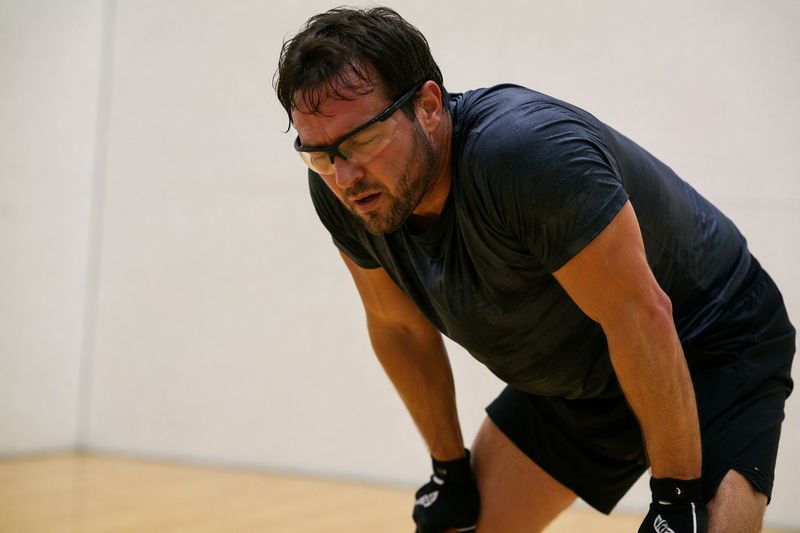
Hard points in racquetball leave fit players bent over and breathing heavy. PubMed’s Oxygen cost and energy expenditure of racquetball, PMID 18091677, treats the sport as a cardiovascular problem as much as a skill test.
Why the oxygen-cost lens changes the story
Oxygen cost is the cleanest way to explain racquetball’s grind because it measures how much work the body is doing to keep play alive. In exercise physiology, intensity is often summarized in METs, and 1 MET is conventionally defined as 3.5 mL O2 kg-1 min-1 of oxygen consumption. That gives coaches and players a common language for comparing racquetball with a steady jog, a conditioning circuit, or any other repeated-effort workout.
The key difference is rhythm. A racquetball rally is built on short bursts of sprinting off the wall, recovering from awkward rebounds, stopping abruptly, and exploding again. That pattern makes the game feel more like interval training than continuous running, because the body has to keep shifting between high-intensity efforts and brief recovery windows without ever fully settling down.
How the court geometry drives the workload
Court geometry is part of the story too. A standard court is 20 feet wide, 40 feet long, and 20 feet high, which means the action is compressed into a tight box where the ball can carom off walls in ways that force constant changes of direction. The walls do not reduce the work. They multiply the number of unpredictable movements players have to make.
That geometry turns the game into repeated acceleration and deceleration rather than straight-line running. Every sprint toward a rebound, every split-step near the short line, and every recovery after a deadening wall angle asks the same thing from the body: produce force quickly, then recover fast enough to do it again. In that sense, racquetball stresses both aerobic recovery and anaerobic bursts at the same time.
The International Racquetball Federation’s official rules, published in August 2024, recognize singles for two players, doubles for four players, and a three-player variation called cut-throat. Workload changes with format: singles demands more ground coverage from each player, while doubles and cut-throat alter how long rallies last and how often each player has to reset for the next burst.
Why fit players still gas out
This is where racquetball surprises athletes who already train hard in other sports. A player can have a strong cardio base and still run out of steam quickly because the sport rarely gives enough time to reset between rallies. The body is asked to recover, but not fully, and then it is thrown right back into another effort spike.
That is also why match length and opponent level matter so much. A shorter exchange against a passive opponent can feel manageable, while a longer rally against a player who keeps the ball deep and alive can stack up oxygen debt fast. The more the ball stays in play, the more the body has to keep feeding repeated high-intensity movement with incomplete recovery.
For conditioning, the lesson is practical and immediate:
• Build repeat-sprint capacity, not just steady endurance.
• Train change-of-direction work, because racquetball punishes linear fitness alone.
• Use short-rest intervals in practice to mirror rally demands.
• Take recovery seriously between matches, because the sport does not give you much of it during play.
A single match can mimic a structured interval session, with the added challenge of reacting to a moving target and a rebound off the wall.
From a 1940s invention to a modern fitness test
Joseph G. Sobek, who lived from 1918 to 1998, developed racquetball in the 1940s while working in a rubber manufacturing plant in Bridgeport, Connecticut.
USA Racquetball maintains rules, rankings, history, and record books, while the International Racquetball Federation provides the official rules and court specifications that define the game’s geometry and formats.
The Sports & Fitness Industry Association’s February 27, 2025 topline participation report put the number of active Americans in 2024 at 247.1 million.