Riverhounds plan 15,000-seat stadium expansion on Pittsburgh's South Shore

The Riverhounds’ $125 million stadium plan would raise capacity to 15,000 without moving off the South Shore footprint that has become part of the club’s identity. That matters because this is no longer just a soccer project: it is a bid to make Pittsburgh Riverhounds SC a larger civic institution, with business, branding and public funding now carrying as much weight as the next result on the field.
A bigger stadium without leaving the riverfront
The expansion is built around a simple but consequential target: 15,000 seats. That number is tied directly to U.S. Soccer’s Pro League Standards, which require 15,000 seats for Division One sanctioning, so the club’s plan is not only about adding inventory for bigger matches but about aligning its venue with a higher level of ambition.
The Riverhounds say the current footprint will remain intact. Instead of abandoning the site or starting over somewhere else, the plan calls for scaling up the three existing stands and adding new amenities around the stadium. That approach preserves the setting that has become part of the venue’s appeal, including the river views that look across the Monongahela toward downtown Pittsburgh and the Fort Pitt Bridge.
Why Station Square still defines the club

The stadium sits at Station Square on Pittsburgh’s South Shore, a location that has always given the Riverhounds something rarer than a generic suburban home: a place that is visibly tied to the city. When the venue opened on April 13, 2013, after ground had been broken on June 25, 2012, it carried a total cost of $10.2 million, raised entirely through private investment.
The club has long described the building as the first soccer-specific, team-owned stadium in USL Pro, and that distinction still shapes how the organization talks about its future. The original stadium was not just a place to play matches. It was a statement that lower-division soccer in Pittsburgh could own its environment, control its revenue streams and build a recognizable home that felt rooted in the city rather than borrowed from it.
That is the foundation the expansion is now trying to extend. The Riverhounds have invested significant capital and effort into the stadium and the surrounding soccer development since 2014, and the new plan treats that investment as the base layer for a much bigger public presence.
The business case goes beyond game night
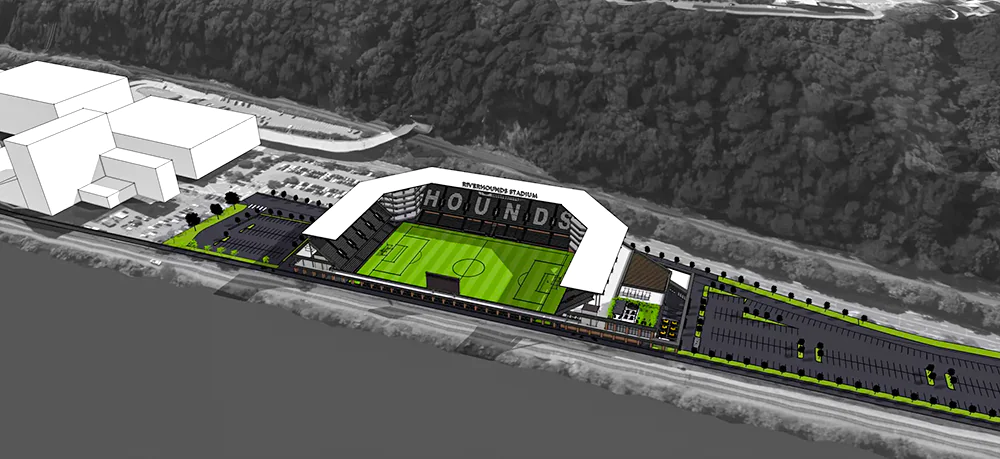
The most revealing part of the club’s vision is not the seat count. It is the estimate that the broader campus and surrounding activity could attract half a million visitors annually once the full vision is realized. That figure shows how the Riverhounds are thinking about the project as a year-round destination, not just a venue that fills on match days.
The development around the stadium already points in that direction. The Distillery Complex, Highline Pittsburgh and the Glasshouse Apartments frame the South Shore site as part of a larger mixed-use corridor rather than an isolated sports outpost. In that context, the Riverhounds’ stadium is becoming an anchor for foot traffic, residential life and leisure activity that extends well beyond USL Championship weekends.
That broader framing helps explain why 2025 felt like a turning point for the club. The team is still known for what happens on the grass, but the off-field infrastructure is now driving the conversation around the club’s long-term place in Pittsburgh sports. For a lower-division side, that shift is the real story: the venue, the adjacent development and the club’s own brand are beginning to reinforce each other.
Branding, partnerships and the next layer of investment

The stadium’s identity has also kept evolving. In April 2026, the venue was renamed F.N.B. Stadium, while Highmark Health and Allegheny Health Network remained long-term partners of the club after the naming-rights change. That continuity matters because it shows the Riverhounds are not simply swapping signs on a building. They are managing a wider commercial ecosystem built on stable relationships and a stadium that has become valuable enough to attract renewed branding interest.
The project’s financing still has a public component. Local reporting said owner Tuffy Shallenberger and the Riverhounds are seeking a $7 million state grant as part of the expansion effort, a reminder that even a privately driven club still needs public-private coordination to move a project of this size forward. That grant pursuit puts the stadium plan in the same category as other major sports infrastructure efforts: ambitious on paper, but dependent on alignment between ownership, government and regional stakeholders.
The stakes here extend beyond the Riverhounds’ own match results. A 15,000-seat stadium on the Monongahela would change how Pittsburgh sees the club, how USL Championship peers measure its ambition and how the South Shore absorbs year-round traffic. The Riverhounds built a legitimate home with private money in 2013; the next phase is about proving that the home can become a durable civic asset.