On November 1, 2026, the Cincinnati Bengals beat the Tennessee Titans 43-36 — a perfectly ordinary-sounding NFL score, except for one thing: in more than a century of professional football, that exact final had never happened before. It was the 1,098th unique scoreline in NFL history, and the third time the 2026 season had already written itself into the record books before the calendar hit November.
What Is Scorigami — And Who Started It?
Scorigami is a concept created by Jon Bois, and the premise is deceptively simple: every time an NFL game ends on a final score that has never occurred before in league history, that result is a Scorigami. No trophy, no official recognition — just the quiet, slightly obsessive satisfaction of knowing two teams just produced a number combination the sport had never reached.
The concept lives on a grid. Winning scores run along one axis, losing scores along the other, and every cell represents a possible final score. When a combination occurs for the first time, that cell fills in. Popular endings — the kind of 27-24 or 31-17 finishes that show up in highlight reels year after year — appear as dark, heavily filled squares. The blank cells are the ones the NFL hasn’t touched yet. A Scorigami board captured as of September 13, 2026 is documented on Wikipedia, giving fans a verifiable snapshot of exactly where the grid stood when the current season began.
Bois built this as fan culture, not an official NFL statistic — but the community that grew around it is real, active, and genuinely gripped every time a fourth quarter starts trending toward unfamiliar territory. The nflscorigami.com tracker, built on Bois’s original concept, lets fans cross-reference the live score against the full historical database as games wind down.
The 2026 Season’s Three Scorigamis, Ranked by Drama
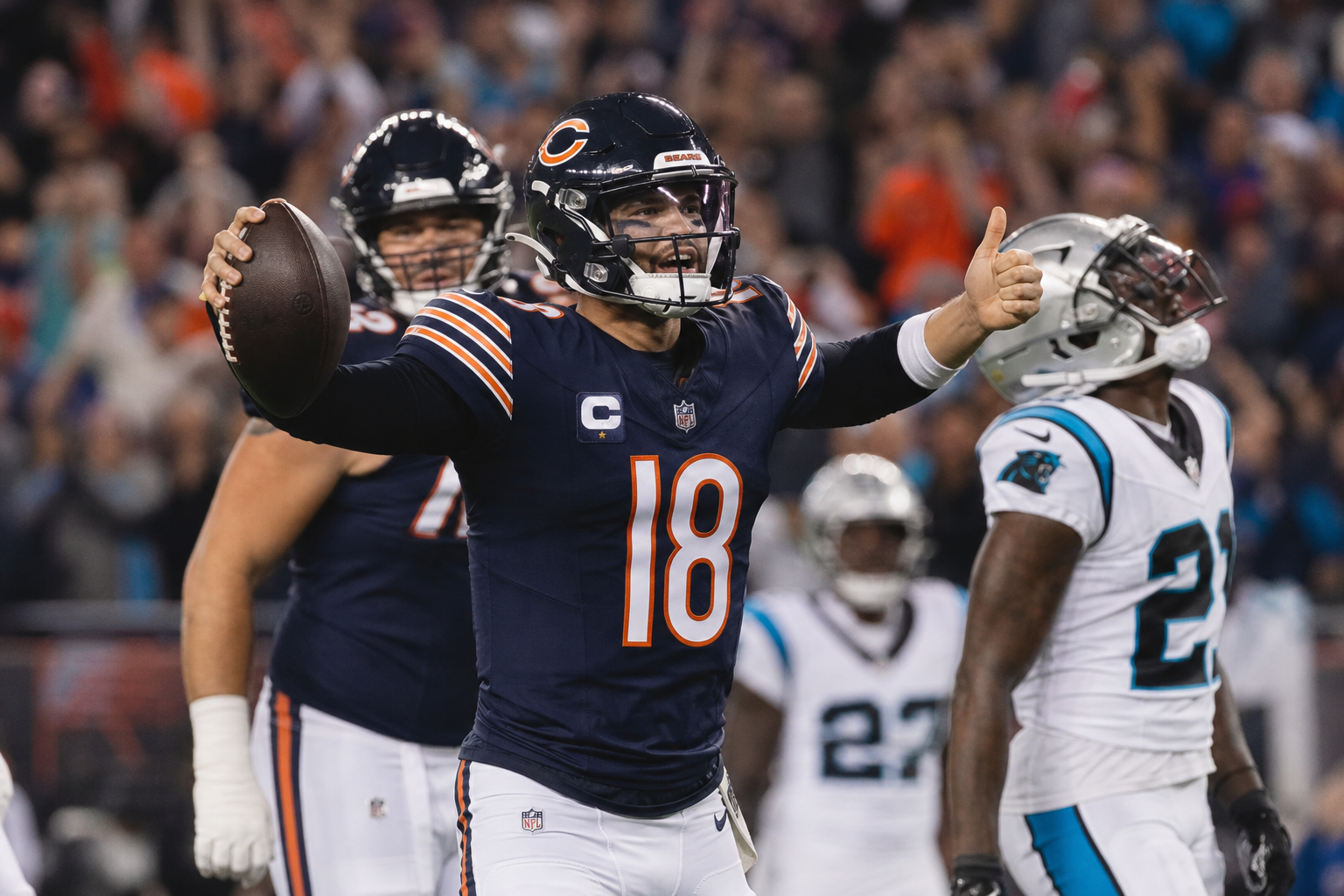
No. 1 — Bears 59, Panthers 37 (Week 1)
Chicago’s blowout of Carolina on opening weekend was the first piece of history the 2026 season served up. High-scoring, lopsided games are fertile Scorigami territory: the NFL rarely reaches extreme combined totals, and when it does, the specific split between winner and loser often falls into blank grid space. A 59-point winning score is unusual enough on its own; pair it with a 37-point loser and you are deep in a part of the board that almost never gets visited. The combined total of 96 points would rank among the highest-scoring games in NFL history, which is precisely why that corner of the grid had sat empty.
No. 2 — Vikings 39, Packers 22 (Week 1)
The same opening weekend doubled the rarity. Minnesota’s win over Green Bay was confirmed as the 1,097th unique score in NFL history — the second Scorigami of Week 1 alone. The 39-22 combination is a useful illustration of how Scorigami works in practice: 39-point winning totals happen, and 22-point losing totals happen, but across every NFL season ever played, those two numbers had simply never appeared together on the same final scoreline. A division rivalry game produced a historic result, and most fans in the building had no idea.
No. 3 — Bengals 43, Titans 36 (Week 8, November 1, 2026)
The most recent confirmed Scorigami is also the most instructive. This was not a blowout or a statistical freak show — it was a competitive, high-scoring game between two AFC teams. The 43-36 final became the 1,098th unique score in NFL history, proving that Scorigami is not reserved for record-setting performances. Games pushing toward 40 points on both sides enter territory the grid visits less often, and the specific pairing of 43 and 36 had stayed blank for more than a century of professional football until Week 8 of this season.
Why Some Scores Are Impossible — And Some Are Just Very Unlikely
NFL scoring works in fixed units: a safety is worth 2 points, a field goal 3, a touchdown 6, with extra-point and two-point conversion variations layered on top. That structure means certain totals are simply unreachable as final scores. A team cannot finish on 1 point. Scores such as 1-0, 2-1, or 4-0 cannot occur under any sequence of legal NFL plays. Those cells on the grid are permanently blank — not waiting to be filled, but structurally off the board entirely.
The more interesting territory is the crowded middle. Common NFL endings — 27-24, 24-17, 31-20 — have occurred dozens of times each. A 27-24 final, for example, is emphatically not Scorigami territory: that exact scoreline has appeared repeatedly throughout NFL history. The board is thick with familiar results in the 14-to-35 point range for both teams, which is precisely where the statistical bulk of NFL games land.
The blank territory opens up at the extremes: very high combined totals, unusual winning margins at moderate scores, or lopsided finishes involving backup offenses and defensive touchdowns that push numbers into odd multiples. The core reason Scorigami still happens in 2026 — after more than a century of professional football — is that the combinations are finite but the sport has not played long enough to fill every reachable cell. The grid is large. The NFL is old, but not that old.
What Makes a Score More Likely to Be a Scorigami
Not all NFL games carry equal Scorigami potential. Several patterns make a blank cell more likely to get filled:
- Very high combined totals. Games pushing past 75 or 80 total points visit territory the league rarely reaches, which means unusual splits between winner and loser are more likely to be firsts.
- Unusual margins at moderate scores. A 39-22 final is notable precisely because neither number is extraordinary on its own — it is the specific combination that had never landed before.
- Lopsided games with odd scoring sequences. Defensive touchdowns, missed extra points, two-point conversions, and late safeties can nudge a score into atypical multiples that sit outside the statistical mainstream.
- Late-season weather games. Cold, windy conditions that suppress offense and force aggressive fourth-down decisions can produce exactly the kind of strange, low-scoring finishes that fill corners of the board.
Fans tracking the grid in real time can use the NFL Scorigami tracker at PrimeTime Sports Talk to check whether a developing fourth-quarter score would land on blank territory — which makes the final minutes of an otherwise unremarkable game genuinely worth watching.
The Rarest Corner of the Board: Scores That May Never Happen
Beyond the structural impossibles, there is a zone of scores that are theoretically reachable but practically implausible. A winning score above 65 points paired with a losing score below 7 would require a historically anomalous performance — the kind that has no precedent and may never produce one. Those cells sit at the outer edge of the grid, technically fillable, but likely to wait decades or longer.
There is also a crowding effect working in reverse. The more games the NFL plays — and the league has expanded the regular season and added playoff rounds over the decades — the faster the familiar-score cells fill in multiple times over, which is exactly what leaves only the outer edges as genuine Scorigami candidates. The common territory grows more common. The rare territory stays rare, or effectively gets rarer as the realistic remaining blank cells cluster further from where most games land.
The honest framing is that nobody can say with certainty which cells will never be filled. That uncertainty is precisely what makes watching a 43-36 fourth quarter compelling for anyone following the grid. The NFL has been played for over a century. It still has not seen every score it is capable of producing.
What to Watch the Rest of 2026
Three Scorigamis before November puts 2026 on pace to be a notable year for unique scores. Not every NFL season delivers multiple new grid entries, which makes the current season’s early production worth tracking closely as the schedule moves into its second half.
The conditions most likely to produce more: late-season games where offenses operate at full speed and weather or playoff positioning pushes coaches toward aggressive decisions. Two-point conversions aimed at unusual totals, defensive touchdowns on otherwise routine possessions, and games that escape normal structure — these are the situations where the grid gets written into.
Scorigami gives casual fans a secondary storyline running through every game on the schedule. A blowout becomes historically meaningful. A weird, lopsided finish becomes something worth remembering. The @NFL_Scorigami account on X calls them out in real time, turning what might be an anticlimactic garbage-time fourth quarter into something worth watching to the final whistle.
The number to hold onto heading into the second half of the season: 1,098 unique final scores across more than 100 years of NFL football — and the grid is still not full.