Team USA dodgeball roster highlights players from all walks of life

Team USA’s dodgeball roster reads like a cross-section of American work life, not a narrow athlete pipeline. Amanda Sayers designs toys, Anne Koester works in communications in New York City, Brandon Cook is a tile and masonry apprentice in Corvallis, and Darcy Johnson works for USPS in Portland. The through line is bigger than the box score: dodgeball’s national team is being built by people who found the sport in school gyms, camp blacktops, church leagues and pick-up circuits, then stayed with it long enough to turn it into a world-level pursuit.
A roster built from real lives
The most revealing thing on the roster pages is how ordinary the first entry point often is. Sayers says she joined her first dodgeball league during her senior year of college while writing a thesis on recreational dodgeball in West Hollywood, which is about as clear a sign as any that this sport now attracts people who study it as well as play it. Koester’s path runs back to childhood parochial school, Cook remembers elementary-school P.E. and a broken thumb, and Brett Batky’s memory is tied to blacktop games at summer camp while he now works in accounting in the Washington, D.C. area.
Brett Granfors adds another common route: he returned to dodgeball through a pick-up league in Albany after spending years mostly in baseball and softball. Darcy Johnson’s path is just as revealing, moving from softball and other team sports into a more committed dodgeball life while working for USPS in Portland. None of those biographies feels staged for novelty. Together they show a sport that is drawing adults who already understand competition, repetition and team structure, then giving them another arena to use it.
The common thread is variety, not a single pipeline
The deeper value of the roster page is that it keeps widening once the familiar names are out of the way. Ed Prentiss, Justin Berni, Kevin Pack, Jamie Jackson, Kate Bergsgaard, Lindsey Ford, Yang Ku, Brett Furlong, Niko Nodal, Jake Mason and Duane Wysynski all point to different routes into the same national pool. Church leagues, schoolyard games, pick-up circuits, martial arts, national and international tournaments, and multi-sport backgrounds all show up in the mix.
That matters because it tells you what elite dodgeball in the United States actually looks like now. It is not one clean feeder system with one obvious answer. It is a sport where a player can come from martial arts, another from baseball and softball, another from a church league, and still all end up under the same Team USA umbrella. That breadth makes the roster feel less like a directory and more like a snapshot of how a niche sport matures: by absorbing different kinds of athletes instead of forcing every athlete through the same tunnel.
How Team USA is assembled
USA Dodgeball says it is the U.S. governing body for dodgeball, recognized by the North American Dodgeball Federation and the World Dodgeball Association, now the World Dodgeball Federation. Team USA represents the United States in international matches on behalf of USA Dodgeball, and the players come from member leagues and teams across the country. That setup gives the roster page real institutional weight. It is not a loose collection of pickup standouts. It is the front end of a national program.
The selection process makes that even clearer. USA Dodgeball says coaching staff choose the final teams for the World Dodgeball Federation’s annual World Championship and other national and international events. Candidates must be registered members, and they are judged on skills, teamwork and conduct. The World Championships page goes a step further, saying scouts are also watching how players conduct themselves online. That is the kind of detail that separates a serious international program from a casual recreation scene. It means the standard is not only about how hard someone throws, but how they fit into a team and represent the program away from the court.
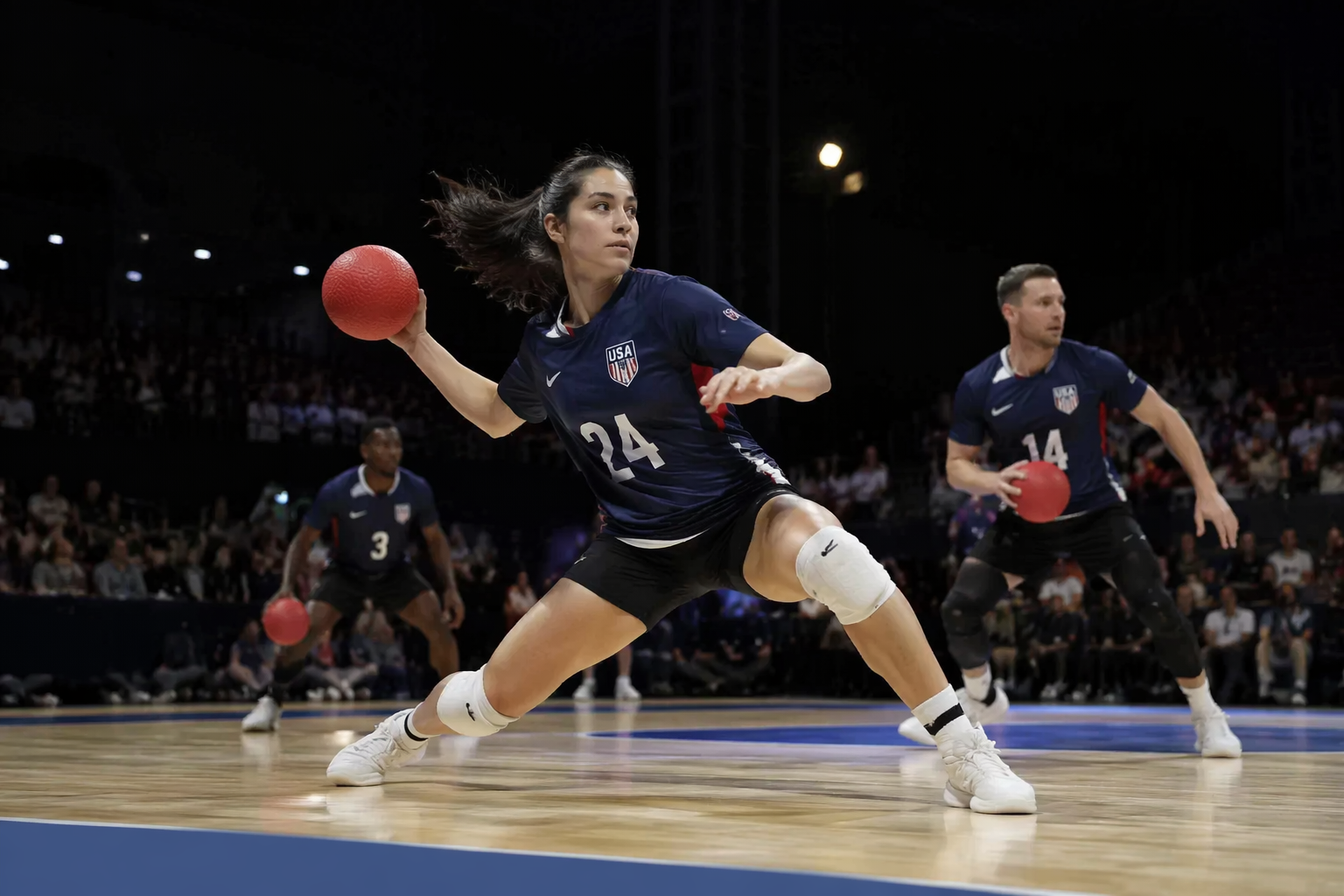
The Premier Tour adds another layer to the pipeline. USA Dodgeball says it runs a flagship event series across women’s, men’s and coed divisions in regions across the United States. That tour helps explain how the talent pool stays fresh and connected. The national team is not just finding players at the top level, it is building a ladder underneath them.
The medal record shows the level of the program
The biographies matter more because the results are already there. USA Dodgeball says the men’s and women’s teams have combined for 17 team medals at the World Championships. It also says Team USA swept both the men’s and women’s divisions on home soil in 2015 and repeated the feat in Cancun in 2019, making the United States the only country to sweep gold twice.
That is not the résumé of a novelty act. That is the record of a program with expectations, continuity and a standard that other countries have to measure against. When a roster page can carry toy designers, accountants, postal workers and apprentices, and still sit beside that kind of medal history, the sport looks a lot more established than the old recess stereotype would suggest.
The world stage has grown with it
The World Dodgeball Federation has been making that same point on a larger scale. The 2022 World Championships were held in Edmonton, Canada, after a multi-year COVID-related hiatus, and the event expanded to six divisions with the addition of cloth and mixed categories. That expansion matters because it shows the sport widening its competitive footprint rather than shrinking into a single format.
By the time the 2024 World Championships arrived in Graz, Austria, from August 11-17, 2024, the federation was calling it the largest event in the sport’s history. Event materials listed more than 1,300 athletes, coaches and officials from 123 teams representing 35 countries, and a later federation summary pushed the total above 1,400 athletes and officials from 36 countries, with all six continents represented for the first time. The venue, RAIFFEISEN SPORT PARK GRAZ, sat at the center of that expansion, and the event page showed the breadth of the competition across divisions such as foam men and cloth mixed.
That is the strongest argument the roster pages make. They are not just introducing players. They are showing how a national team can be built from working adults, former youth players, multi-sport veterans and tournament lifers, then carried into a world championship structure that now spans six divisions and a truly global field. Team USA’s roster does not just reflect where dodgeball came from. It shows how far the sport has already gone.