The Greatest keeps sideline throws alive in ultimate
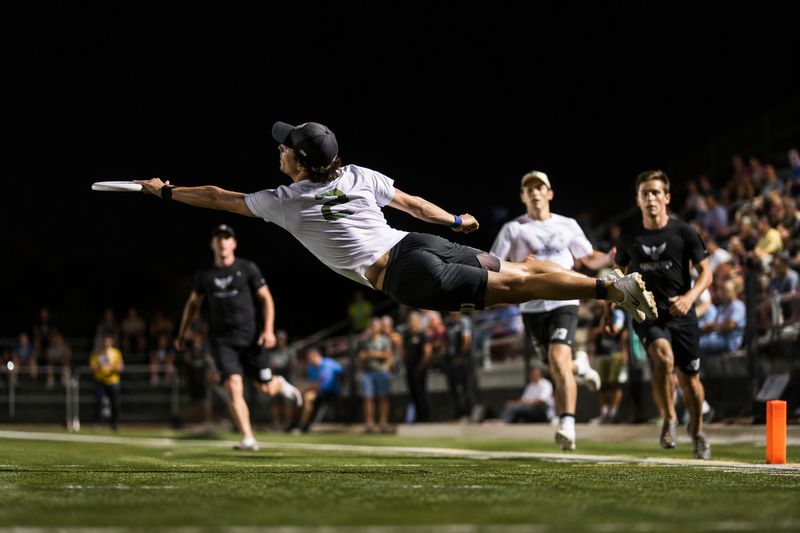
A receiver leaves the field, catches the disc in the air, then snaps it back to a teammate before landing out of bounds. In ultimate, that play is The Greatest, and the save lives or dies on one tiny detail: the first point of contact after the catch must be inside the playing field.
How The Greatest works
The Greatest is a boundary play built on body control and rule precision. The play starts with an in-bounds takeoff and ends with the disc thrown back into play before the receiver lands out of bounds. Under WFDF’s rules, if you catch the disc after jumping, your first point of contact has to land inside the field, and the sideline itself is not part of the playing field.
That is why the play looks so much more dramatic than it is random. A disc that appears overthrown in another sport can still stay alive in ultimate if the receiver can get back to the field by the time a foot, toe, or other first contact hits. In a game where incomplete passes create immediate turnovers, that single extra touch can preserve a possession that should have ended.
Why the sideline becomes part of the offense
Ultimate is a seven-a-side sport played on a field about the length of a football field but narrower, which means the alley near the sideline is always tight. When a throw rides that line, the receiver is not just chasing a disc, but solving a spatial problem at full speed.
A save that keeps the disc in play can erase a bad angle, punish a throw that would be harmless in other sports, and extend a possession without breaking the flow. The sideline is still out of bounds, but the closest blade of grass to it can decide whether the offense gets a reset or hands the disc away.
The skill set behind the save
The Greatest is not a circus trick. Ultimate showcases athleticism, skill, teamwork, and character, and this play condenses all four into one airborne moment. The receiver has to read the disc’s flight, judge the body angle needed to reach it, and decide in a split second whether to lay out, tap a toe, or release a throw before momentum carries the body fully out.
That instant decision-making matters because ultimate is non-contact, self-officiated, and built around Spirit of the Game. Players are responsible not only for making the play but for knowing the rule that makes the play legal. The Greatest rewards athletes who understand the rulebook as well as they understand timing, because the cleanest effort is useless if the first contact lands on the wrong side of the line.
The hidden participants on the sideline
The second half of The Greatest is shaped by people and cues that do not show up in the box score. In ultimate, the players on the field have to judge the line for themselves, because Spirit of the Game places the responsibility for fair play on every player. That makes the sideline more than a visual border: it becomes a shared reference point for in/out decisions, spacing, and the timing of the throw itself.
Spacing is part of the play before the disc is even released. A thrower who knows a receiver can work the boundary may aim toward the line on purpose, and a receiver who expects that pass will already be planning the escape route back in bounds. Teammates and defenders read the same geometry, which means the save often begins with anticipation rather than with the leap.
The line also shapes what the rest of the offense can do around the play. Because the sideline is not part of the field, every cut, pivot, and recovery route has to respect a strip of ground that cannot be used as a landing zone.
From Columbia High School to a global skill
Modern ultimate traces to the summer of 1968 at Columbia High School in Maplewood, New Jersey, where the founders experimented with rules while playing with a Frisbee.
WFDF says ultimate is played by an estimated 100,000 players in more than 50 countries, while USA Ultimate lists more than 31,000 members.
Why the rulebook keeps the play alive
Ultimate keeps refining the framework around the play. USA Ultimate’s Rules Working Group updates the official rules and supports players in putting them into practice. WFDF’s rule forum hosted a 2023 discussion about encouraging Greatest plays, citing a disputed World Under-24 final in Prague, Czech Republic, where a Greatest in the end zone sparked debate.