The World Games spotlights ultimate’s global rise in mixed-gender format
The World Games gives ultimate something no club title or standalone world championship can quite match: a place inside a global multisport event, with Olympic-level symbolism attached. Run every four years by the International World Games Association and supported by the International Olympic Committee, the 11-day program has become ultimate’s clearest public showcase outside the Olympic system.
Ultimate’s biggest stage outside the Olympic system
The World Games began in 1981, and the event’s history gives ultimate a larger frame than any single federation championship can offer. Club and world championship tournaments matter deeply inside the sport, but they mostly speak to ultimate’s own hierarchy. The World Games puts the game in front of a broader audience, alongside other elite sports, which is why it functions as ultimate’s de facto Olympic moment.
That is also why Karlsruhe matters so much to the story. The city hosted The World Games in 1989 and is scheduled to host again in 2029, becoming the first city to stage the event twice. For ultimate, that creates a clean historical loop: the sport appeared on the program in Karlsruhe as an exhibition in 1989, then became an official medal sport in Akita, Japan, in 2001, and now returns to the same German host city where its international breakthrough first took shape.
The result is a stage that does more than hand out medals. It offers legitimation, a shared broadcast footprint and a setting where people who do not already follow ultimate can see it as part of the world’s serious sporting calendar. That matters in a sport still working to expand beyond its core audience.
The format that makes ultimate look like ultimate
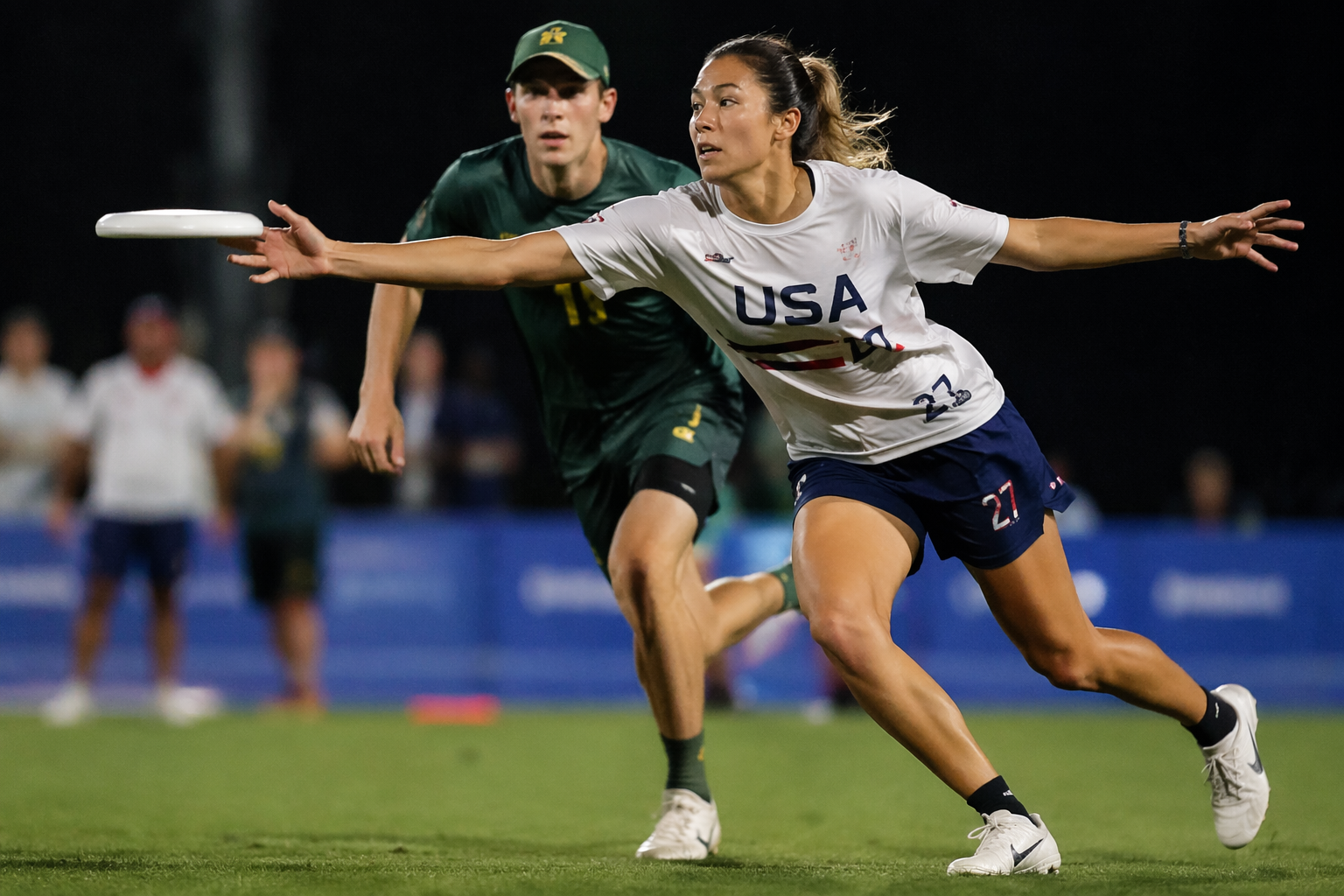
The World Games version of ultimate is mixed-gender, with each side fielding four men and three women, or four women and three men. That is not a cosmetic twist. It reflects one of the sport’s defining strengths, a roster structure that puts gender balance at the center of elite competition rather than treating it as a side category.
It also preserves the sport’s self-officiated identity. Ultimate at The World Games is played under Spirit of the Game, which means players are responsible for calling and resolving fouls and violations themselves. WFDF’s rules framework uses competition-specific variations for special events like The World Games, but the core still looks and feels like ultimate, not a conventional referee-led field sport.
That combination is what makes the event such a useful measuring stick. The mixed format shows the sport at its most inclusive and most tactical at the same time. The self-officiated structure keeps the game rooted in the culture that has helped ultimate define itself internationally, even as it seeks wider recognition.
Team USA’s standard, and the podium that followed
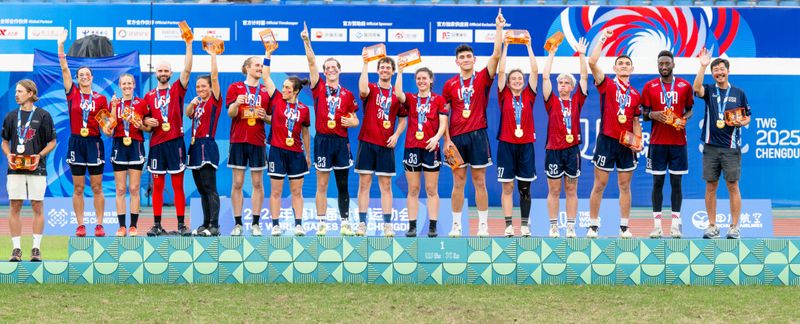
The United States has turned The World Games into a long-running standard of excellence. USA Ultimate fields a 14-person mixed-gender roster, and Team USA won gold in five straight editions from 2005 through 2022 before taking a sixth consecutive title in Chengdu in 2025. That run gives the event competitive weight far beyond a one-off showcase, because the same stage has become the place where the sport’s best teams are expected to prove themselves again and again.
The 2025 roster underlined that depth. USA Ultimate’s team included nine athletes with previous World Games ties and four players making a third appearance after also competing in 2017 and 2022. The lineup was evenly split between men and women, and the continuity showed in familiar names such as Carolyn Finney, Dylan Freechild, Chris Kocher and Grant Lindsley.
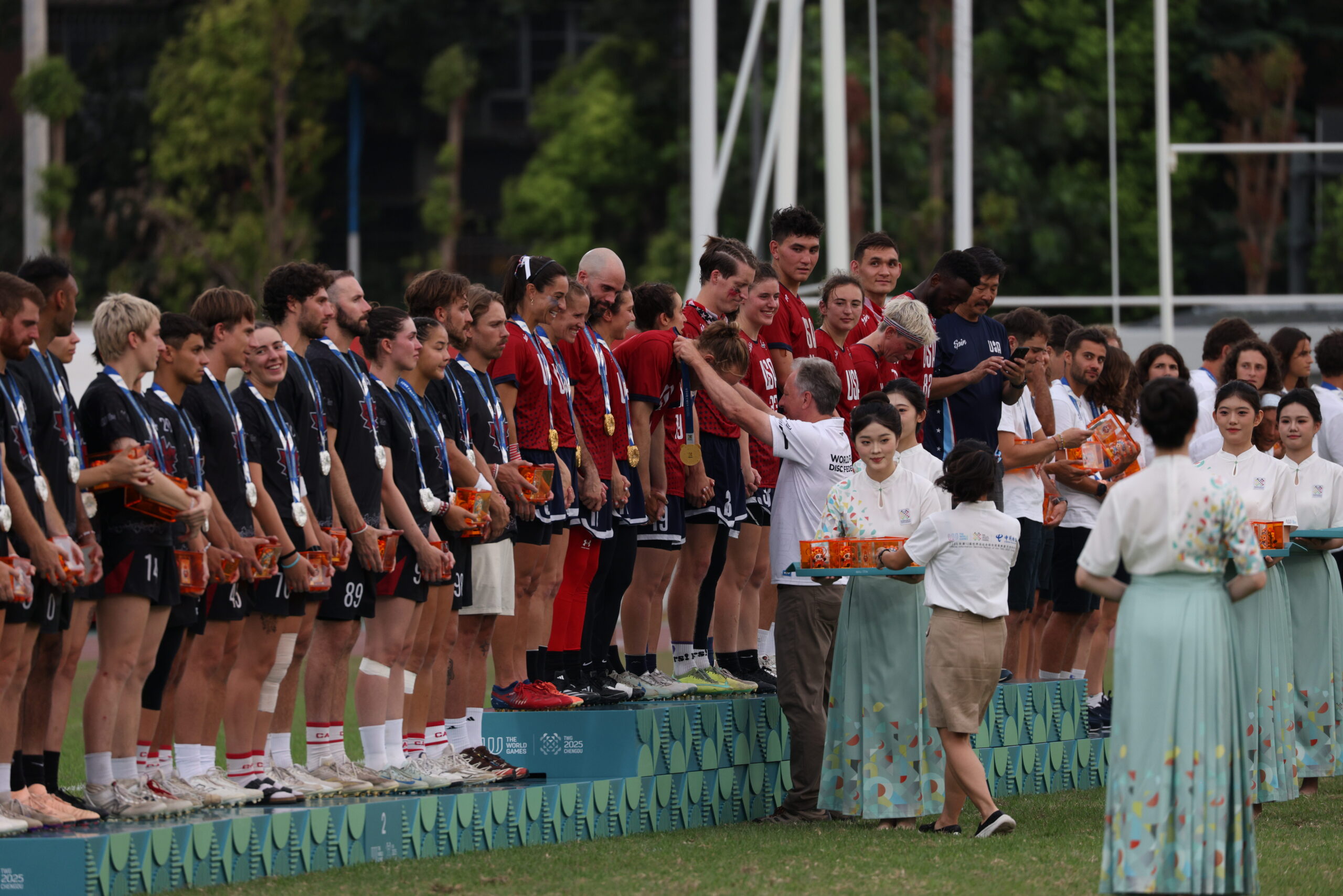
Chengdu’s medal table gave the tournament broader international texture. Team USA won gold, Canada took silver and France earned bronze, while Germany was named the unofficial Spirit winner through peer voting. The field itself was compact enough to follow and strong enough to matter, with the U.S. also beating Japan, Germany, China, France and Canada on the way to the title. That mix of results shows both American dominance and the sport’s growing geographic spread.
Why Chengdu deepened the global case
The 2025 World Games were held in Chengdu, China, at Chengdu Sport University, and the finals stretched across five days. USA Ultimate noted that the Games returned to Asia for the first time since 2009, which gave the event added value as a regional showcase and not just a championship stop for North American and European audiences.
That setting matters because ultimate’s mainstream case depends on visibility outside its usual centers. A mixed-gender medal event in China, under a multisport banner, gives the sport a different kind of reach than a club world championship can deliver. It places ultimate in the same conversation as the broader international sporting system, with federated rules, national teams and medal stakes that casual fans can understand quickly.
The sport’s leaders have spent years building toward that credibility. WFDF governs flying disc sports internationally, and The World Games is the place where that governance becomes visible to everyone else. In practice, that means ultimate is not just competing for medals. It is competing for recognition, and The World Games is still the clearest proof that the sport belongs on a larger stage.
Karlsruhe closes the loop
The 2029 return to Karlsruhe gives the story an unusually neat shape. A city that hosted ultimate’s first World Games appearance in 1989 will host the event again four decades later, after the sport has moved from exhibition status to medal sport and from niche curiosity to a fixture of the World Games program.
That is why The World Games matters more than any other non-Olympic stage. It gives ultimate a global audience, a mixed-gender format that reflects its identity and a competitive setting that can be measured against the wider world of elite sport. For a game still chasing mainstream recognition, that is the closest thing to the Olympic spotlight it has.
Sources
- [1]usaultimate.org
- [2]theworldgames.org
- [3]wfdf.sport