UFA playoffs begin, Round 1 preview sets the championship chase</final
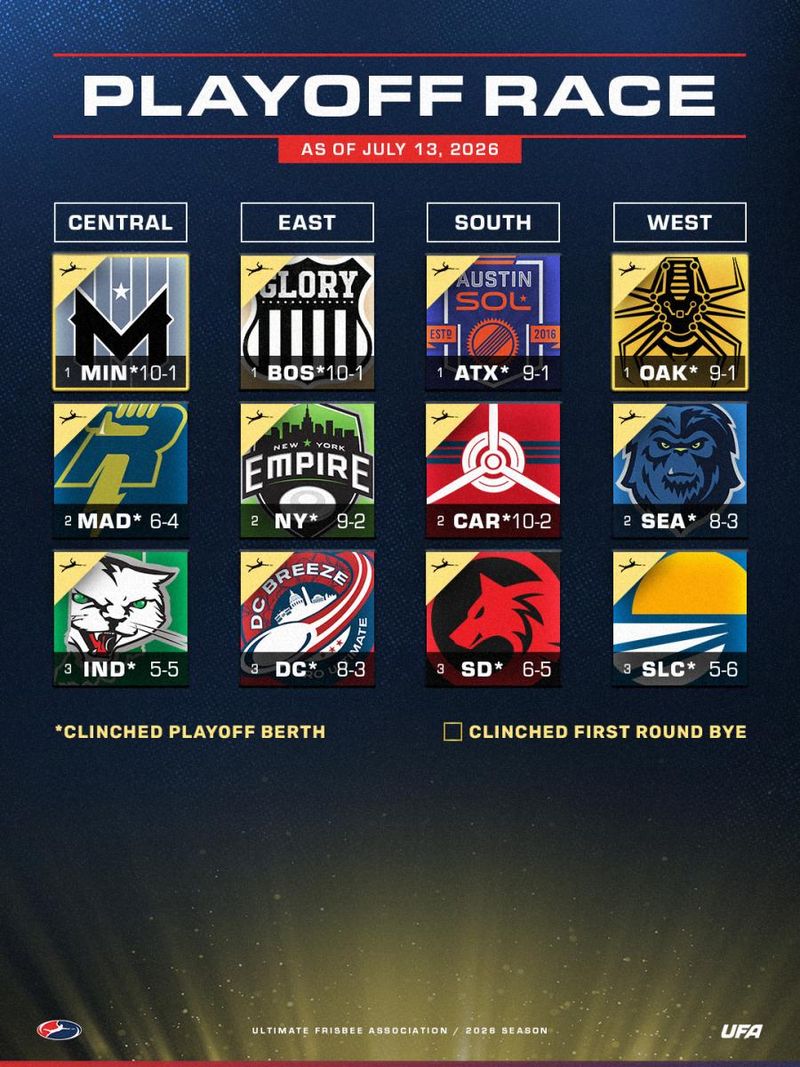
The UFA regular season has stopped being a 13-week résumé and turned into a 12-team survival test. Ultiworld’s Week 13 Buzzer Beater preview arrives with the bracket about to lock, and the hard truth is simple: the clubs that looked strong in June now have to prove they can cash in under elimination pressure.
The bracket is set, and the calendar is the first pressure point
WatchUFA has 12 playoff teams lined up for 2026, with the first playoff game set for Friday, July 24. The postseason will stretch across 11 games involving 22 teams across North America, which means the title path is not just about talent, but about how fast a team can reset after every high-leverage night.
The regular season ran from April through July, so the teams entering this bracket have spent months building identities. That matters now because Round 1 does not reward reputation. It rewards the clubs that can turn their season-long patterns into clean points when the margin for error disappears.
What regular-season numbers still predict playoff survival
The most predictive regular-season indicators are the ones that survive when every possession feels like a mini series. WatchUFA’s seeding tiebreakers start with head-to-head record, including among three or more teams, then move to point differential in the games played against each other. That is the league telling you which results mattered most before the bracket even started.
That same logic applies to Round 1. The clubs most likely to advance are the ones that can live without a cold quarter, survive a turnover-heavy stretch, and avoid the matchup problems that can flatten a good offense for 10 minutes at a time. In other words, the teams that were efficient in the right games, not just loud on the scoreboard, are the ones with usable playoff data.
A one-goal win over an elite opponent tells you more in this setting than a comfortable blowout over a lower seed. Boston Glory’s 21-20 win over the Minnesota Wind Chill in Week 12 is the clearest example in the current form cycle: that is the kind of result that says both teams can play at the edge, but only one of them gets the cleanest late-game execution.

The top tier enters with real form, not just brand names
Ultiworld’s July 20 UFA rankings place Boston Glory, Minnesota Wind Chill, Oakland Spiders, New York Empire and DC Breeze in the top five. That group is the clearest snapshot of who has combined season-long quality with enough late-season traction to matter when the bracket tightens.
New York made the loudest statistical statement of the week, beating Philadelphia 37-20 in a game that set a franchise goals record. That kind of output is not just a feel-good headline, it is a warning shot. If the Empire are generating that much scoring volume this late, then anyone facing them has to solve two problems at once: stopping the first break and preventing the next one.
Boston and Minnesota arrive with a matchup that already looks like a playoff microcosm. The 21-20 result between them showed how thin the margins are at the top, and it also hinted at the central playoff question for both teams: who can keep their offense on schedule when the game tilts into late-point possession math? Oakland and DC sit in the same tier of conversation because the rankings say they belong there, and because this is the part of the season where being in the conversation is not enough. You have to turn that status into clean round-one execution.
The teams with the best playoff habits know how to do this already
Minnesota’s profile is built on continuity. The Wind Chill are in their 13th UFA season in 2026, and they have qualified for the playoffs in seven of the last eight seasons. That is not trivia now, it is a competitive habit. Teams that reach this stage that often usually know how to survive bad stretches, handle the travel, and stay organized when one mistake can swing the night.
Madison belongs in the same conversation even if the focus is on the top of the rankings. The Radicals are heading into their 14th season in 2026, and longevity matters in a postseason where old habits often beat raw athleticism. A veteran team with a stable identity can look ordinary in July and still be dangerous in a short series if the matchups line up and the back line stays intact.

Round 1 will be decided by specifics, not slogans
If there is one factor that keeps coming back in this kind of bracket, it is efficiency where the field shortens. Red-zone execution matters because possessions are too expensive to waste. Back-line depth matters because one tired defensive unit can give away a game in two breaks. Travel fatigue matters because WatchUFA’s postseason footprint stretches across North America, and that makes recovery part of the competitive edge.
That is why the most useful regular-season indicators now are the ones tied to clean, repeatable performance: • head-to-head results against the teams you might meet again • point differential in those head-to-head games • how often a team avoids turnover cascades • whether the offense can close points after a long defensive set • how a club responds after giving up a run
Those are the traits that show up when the scoreboard gets tight and the crowd gets louder. A team can hide a flaw for 13 weeks. It cannot hide it in Round 1.
A familiar late-July checkpoint
This is also becoming a familiar slot in the league calendar. Ultiworld published a similar playoff preview on July 22, 2024, and the timing says everything about how the UFA season is built. By late July, the regular-season argument is over, the rankings have done their sorting, and the only thing left is whether a team can translate its profile into another week of survival.
Boston, Minnesota, Oakland, New York and DC have earned the spotlight. Now the bracket strips away the padding, and the clubs that keep playing will be the ones that turned regular-season trends into playoff answers.
Sources
- [1]ultiworld.com
- [2]watchufa.com