US Quadball spotlights flag runner as a key officiating role
Quadball's endgame belongs to the flag runner, and that is what makes the sport so easy to explain and so hard to forget. US Quadball's current rules attach the flag to the waistband of a neutral athlete, release that runner at the 20-minute mark, and give the flag 35 points, while the point cap adds 60 to the leading score at that same moment. The result is not a stalling exercise. It is a live athletic chase in which seekers, runners, and the scoreboard all collide at once.
The flag runner turns the last minutes into a real contest
The easiest way to understand quadball's draw is to watch the final phase, because the flag runner changes the meaning of every possession before the horn. Once the runner is released at 20 minutes, seekers are no longer chasing a symbolic finish line. They are pursuing a neutral athlete who can use any means to avoid capture, which makes the role active, evasive, and physically demanding rather than decorative.
That detail matters because the point cap keeps the game alive even when one team is ahead. USQ's current system adds 60 to the leading score at the 20-minute mark, and either team can end the game by reaching that number. In practical terms, a lead is only safe if the team can create it, protect it, and then close it in real time while the flag pursuit unfolds behind it.
For new fans, that is the hook. The final stretch is not a slow burn toward a buzzer. It is a fast, visible duel inside a larger team game, with a 35-point flag capture sitting on top of a point-cap race that can flip strategy in a single play.
How the role works on the field
US Quadball treats the flag runner as part of the sport's core structure, not as a novelty. Every quadball match is officiated by six to seven referees, and USQ lists one flag runner per game alongside that crew. The role is unusual enough to sit inside officiating, yet athletic enough to shape the score directly.
The mechanics are simple on paper and chaotic in motion. The flag is attached to the runner's waistband, the runner is released at 20 minutes, and seekers try to catch it. Because the runner is neutral and may use any means to avoid capture, the job demands balance, acceleration, spatial awareness, and an instinct for reading pressure in tight spaces. That is why the best flag runners are not just quick. They are difficult to trap, difficult to predict, and able to force seekers into bad angles.
The role also changes how the rest of the match is played. A team protecting a lead has to think about the point cap, not just the immediate score, which means endgame defense begins before the flag is even in play. A team trailing can still climb back into the result if it can create a strong enough margin before the 20-minute mark or win the chase after it. In a sport that can look unfamiliar at first glance, the flag runner gives the endgame a clean, dramatic logic.
USQ has built a real officiating path around the position
US Quadball has formalized the flag runner role in a way most sports never do with a live athlete. Certified flag runners who are 17 or older can be paid $10 per official USQ match, and officials membership automatically covers HR, LAR, AR, and flag runner certification. That places the position inside the sport's labor structure, with the same kind of development path USQ uses for other officials.
The certification requirements are concrete. A candidate must already be seeker-referee certified, must register with USQ as an official, must complete DEI training, and must submit a W-9 if the work is tied to paid USQ-hosted events. USQ also formalized a tier system, with newly certified flag runners beginning at tier 5 and moving upward after evaluation. That tier ladder gives the role a progression that is closer to an officiating pathway than a one-off assignment.
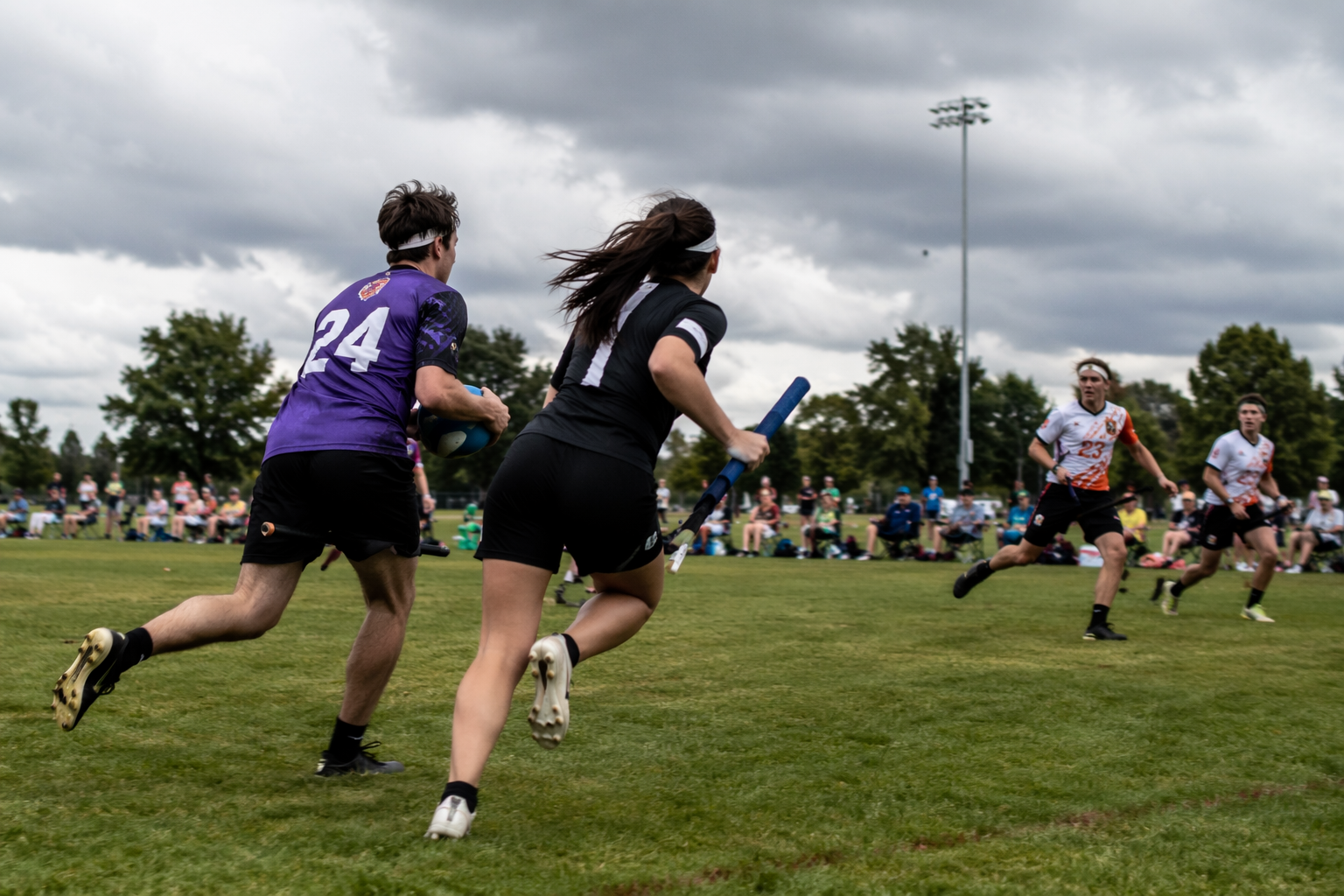
USQ kept refining that structure. In 2025, the federation said it would revise flag-runner payment requirements and the certification and tier system again starting with the 2025-26 season. That tells you how seriously the sport takes the job. The position is not frozen in place; it is still being adjusted as the game professionalizes.
• Certification starts with seeker-referee certification. • Officials must register with USQ and complete DEI training. • Paid USQ-hosted events require a W-9. • Certified flag runners age 17 and up can receive $10 per official match. • New certification begins at tier 5, with advancement after evaluation.
Why the name change mattered, but the chase stayed the same
USQ renamed the snitch-runner team the flag-runner team in 2021, and that change lined up with a broader identity shift. On July 19, 2022, Major League Quadball and U.S. Quidditch announced the move to quadball, a rebrand that NBC News described as part of an effort to distance the sport from Harry Potter and support growth and sponsorship. The name changed, but the defining spectacle did not: a human runner still anchors the finish.
That is why the flag runner works so well as the sport's public face. The new name gave the game cleaner branding, but the old drama survived intact because it was always the most watchable part. Fans remember the chase. They remember the moment the match stops being abstract and becomes a footrace with consequences.
The terminology also fits the way USQ has been shaping the role inside the broader sport. The federation's 2021 language, the 2022 rebrand, and the later officiating updates all point in the same direction: quadball wants the flag runner to be understood as a distinct, legitimate piece of the game, not a leftover from a previous era.
A global rulebook now governs a very local thrill
The International Quadball Association says the sport was adapted by fans in 2005, and its 2024 rulebook is the authoritative rules source worldwide. That matters because it shows the flag runner is not just a U.S. invention or a quirky league preference. It sits inside a formal international framework that now governs how the game is played and judged.
That global standard makes the endgame even more striking. Across leagues and countries, the same basic drama still works: a neutral runner, a live chase, a 35-point capture, and a point-cap finish that forces teams to manage the clock and the score at the same time. Few mainstream sports ask officials, players, and a live athlete to share that much pressure in the final minutes.
Quadball keeps selling itself with contact, pace, and tactics, but the flag runner is the piece that explains why the sport sticks. It gives the last minutes a shape, gives officials a defined role around the chase, and gives fans a finish that looks like nothing else on the field.
Sources
- [1]usquadball.org
- [2]mlquadball.com
- [3]nbcnews.com
- [4]iqasport.org