USA Football maps clear pathway to Team USA flag rosters
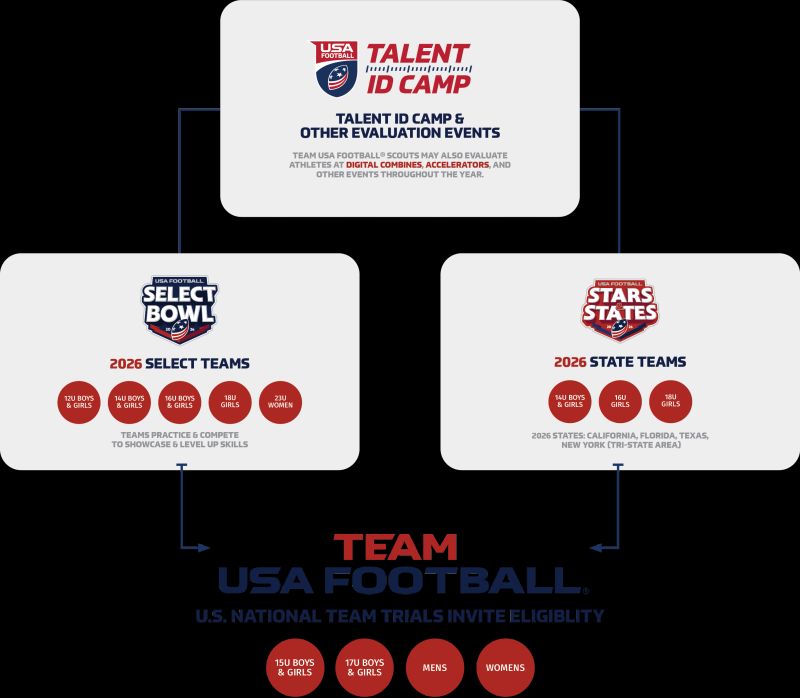
USA Football’s athlete-facing “How to Join a U.S. Flag National Team” page points athletes to the National Team Development Program, Talent ID Camps and recurring men’s, women’s and junior roster pages. Team USA is built through a process, and most athletes get filtered out long before they wear the red, white and blue.
How the pipeline starts
The first gate is eligibility, and the junior side makes that especially clear. USA Football’s 2026 junior selection procedure says 17U athletes must be 17 or 16 as of Dec. 31, 2026, while 15U athletes must be 15 or 14 as of that date. Junior nominees also must be U.S. nationals at the time of selection and hold a valid U.S. passport that will not expire for six months after the event.
USA Football’s public-facing structure, including 2025 junior roster information and 2025 and 2026 men’s and women’s national-team roster pages, shows a recurring cycle rather than a permanent club. Selection is refreshed, reviewed and reopened, which means last season’s status is no guarantee of this season’s call.
What Talent ID Camps are really for
Talent ID Camps are the main on-ramp for athletes who want to be seen by U.S. National Team scouts. Registration is the route to being evaluated, and camp materials describe a mix of combine testing, drills, 1v1s and 5v5 work. One USA Football camp page at the Ford Center in Frisco listed a 9:00 am to 5:00 pm schedule, a $69 price and a requirement that participants be USA Football Athlete Members.
Combine testing rewards raw speed and conditioning, while the 1v1 and 5v5 periods show whether that athleticism survives contact-free chaos, spacing and decision-making. A player who wins in shorts at a testing station but disappears in live reps is not getting very far in this system.
Talent ID Camps are also a development tool for athletes ages 11-20, giving scouts a wider pool. The program is not built only for polished veterans; it is designed to find upside early, then keep narrowing the field until the best few fit the national-team standard.

Where most athletes get cut
The process is built to help national-team coaches evaluate athletes, and the camp format stacks the deck in favor of players who can do a little of everything. If you only win in one lane, you are vulnerable. If you can run, catch, defend and process quickly across multiple situations, you stay in the conversation longer.
Positional versatility becomes more than a buzzword here. With national teams rotating through recurring roster cycles and a competitive process built around camps and evaluations, the athletes who help most are the ones who can slide between roles without losing efficiency. In flag, that usually means a receiver who can also defend space, or a defender who understands route timing well enough to anticipate the next break before it happens.
Callie Brownson, now USA Football’s senior director of high performance and national team operations, sits right in the middle of that machinery. Brownson has said the process created clarity around the fact that “it does take some time.” Team USA is not assembling a highlight reel. It is building a tournament roster, and the athletes who survive are the ones whose film, conditioning and versatility all hold up under the same lens.
Coaches can see speed in a straight line, but they need tape that shows how that speed plays when a route breaks late, when a defender sits on a throw, or when a player can recover after a bad first step. Tournament résumé matters for the same reason: if you have already handled pressure in meaningful games, that carries more weight than a clean workout result with no competitive proof behind it.
The roster process is moving toward bigger stakes
The International Olympic Committee approved men’s and women’s flag football for the Los Angeles 2028 Olympic program on Oct. 16, 2023, and the International Federation of American Football confirmed the route to LA28 qualification in 2026. The national-team structure now sits in the shadow of that Olympic calendar. Flag football is a non-contact version of American football played in two 20-minute halves, a format that rewards pace, space and precision more than brute force.
Sources
- [1]usafootball.com
- [2]espn.com
- [3]nfl.com
- [4]la28.org
- [5]americanfootball.sport
- [6]facebook.com