USA Racquetball Hall of Fame honors broad careers, impact, and leadership
USA Racquetball’s Hall of Fame is built to do more than freeze a few champions in amber. It measures a racquetball life the way the sport actually gets played, across competition, development, leadership, and the people who keep the pipeline alive long after the trophies are handed out. That is why the Hall can place a star like Rhonda Rajsich, a builder like Scott Winters, and pioneers such as Joe Sobek and Bud Muehleisen in the same institutional frame.
What the Hall actually rewards
The nomination system is deliberately narrow and broad at the same time. USA Racquetball sorts candidates into five categories, Professional, Contributor, Amateur Open Player, Amateur Age Player, and Outdoor Player, and says eligibility is only the first gate: once a nominee meets the criteria in any category, the committee reviews the person’s entire racquetball résumé and career. Nominees generally must be at least 40 years old by May 1 of the year after nomination, professional players must have been retired from full-time touring for at least three years, and candidates can be nominated up to three times in a five-year span before a five-year waiting period kicks in. Nominations are due by September 15 in the current framework, but a 2023 notice used an October 1 deadline, which shows the calendar can shift even as the structure stays consistent.
That setup says a lot about what racquetball wants to immortalize. A one-season spike is not enough, and a pure title count is not the whole story. The Hall is designed to recognize competitive excellence, but it also makes room for sportsmanship, contributions that advance the sport nationally, and outdoor performance over time, which is a much wider definition of greatness than a simple leaderboard would allow. A 2023 guide said the Hall had inducted 74 people at that point, spread across pro, amateur, contributor, and outdoor categories, a reminder that the honor stays selective even as the sport keeps adding names.

The current classes show where the sport is headed
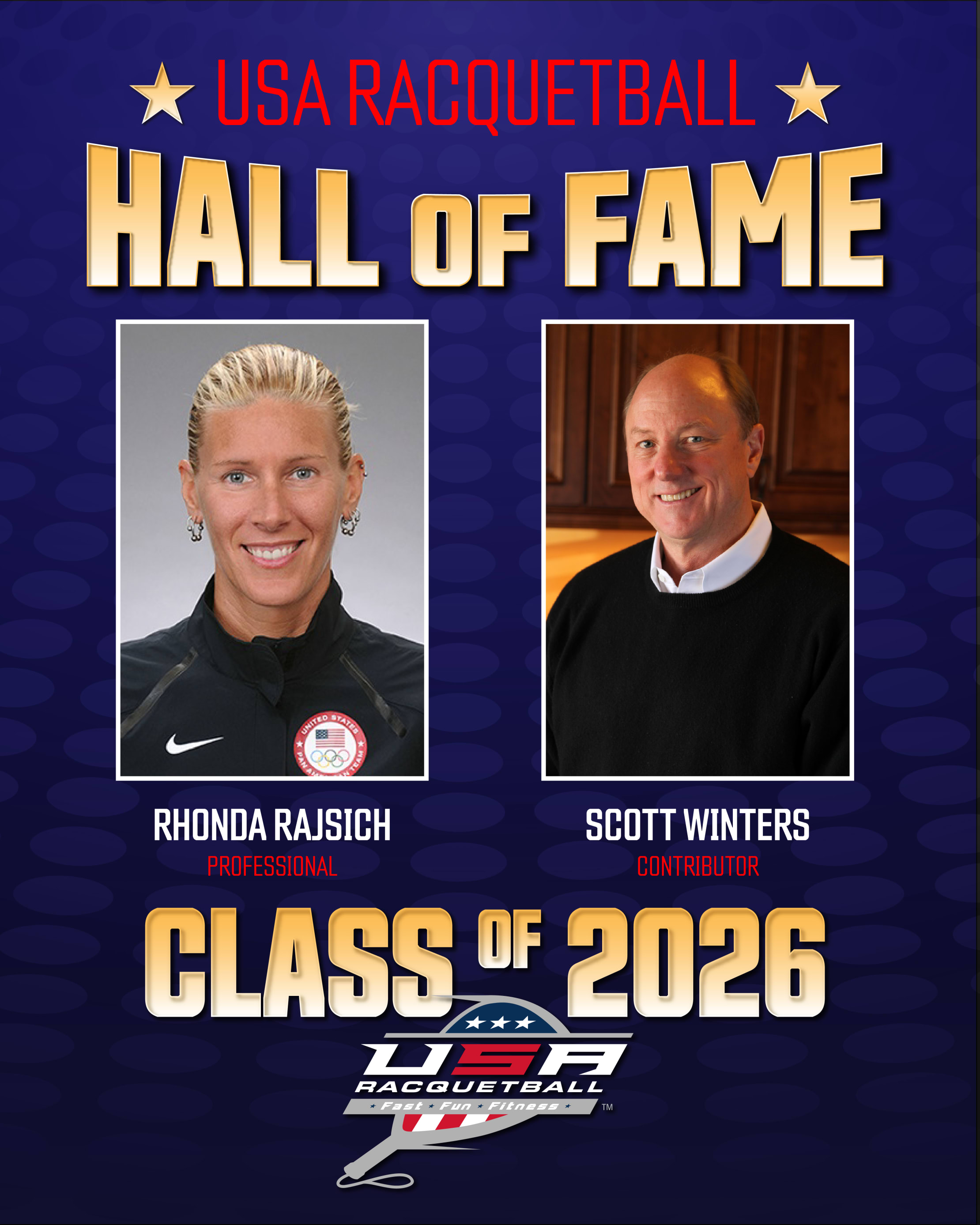
The Hall page now lists 2024 inductees Jim Easterling of Lansing, Michigan and Jack Huczek of Rochester, Michigan, 2025 inductees Christie Huczek of Scottsdale, Arizona and Dave Negrete of St. Charles, Illinois, and 2026 inductees Rhonda Rajsich of Arizona and Scott Winters of Colorado. That mix matters because it shows the Hall still values competitive stars, but it also continues to reward people whose careers spread across playing, coaching, organizing, and promotion.
Rajsich is the clearest example of how the Hall has evolved. USA Racquetball calls her the most decorated female racquetball player of all time and says she is the first Hall of Fame candidate who could qualify for all three categories and be elected on the individual merits of her accomplishments in any of the three disciplines. The numbers behind that claim are massive: she burst onto the scene at the 2000 US Open as a No. 44 seed, finished No. 3 on tour that season, spent the next 20 years in the top 10, owns four year-end No. 1 pro titles, 28 Tier 1 tournament wins, four US Open titles, 12 USA National singles titles, 22 Team USA appearances, 16 IRF singles titles, three IRF doubles titles, nine major outdoor singles titles, and 16 major outdoor doubles titles.
Scott Winters fits the other side of the modern equation: the builder. USA Racquetball describes him as a contributor who built a career in the sport both professionally and as a volunteer to multiple regional and national associations, then helped grow racquetball through club programming and manufacturer work. The same profile says he was instrumental in forming World Outdoor Racquetball in 2004 and helped develop the red Fireball ball that transformed outdoor play in its early years. In Hall terms, that is not side work. It is part of the sport’s infrastructure, and the selection committee clearly treats it that way.
The Hall’s roots still define the sport’s identity
Racquetball’s origin story is unusually clean for a modern sport: Joe Sobek is credited with inventing it, developing the first racquetball racquet, and testing the game with a run of 25 in 1950. That origin matters because the Hall has never been just about the top professionals of one era; it starts with the inventor and the first generation of builders, then carries that lineage forward.
Bud Muehleisen gives the Hall its other foundation stone. USA Racquetball says he was the first inductee alongside Sobek in 1974, won the first national racquetball championships in 1969, and finished with 69 National Indoor Championships plus four national outdoor titles. On the indoor side, he is the prototype of early dominance. On the outdoor side, his record helps explain why racquetball never fully separated court skill from promotion, crossover, and invention.
Women, outdoor players, and builders are not side notes
The Hall’s history also shows that racquetball has long had elite women whose careers were too deep to fit a single label. Lynn Adams, inducted in 1997, won 325 of 369 professional matches for a .887 winning percentage, collected eight Player of the Year honors, six pro tour season titles, and seven overall championships while battling multiple sclerosis. Michelle Gould, inducted in 2012, won the WPRA and WIRT National Pro Singles Championships seven times in eight years from 1990 to 1997, and finished with 39 US national titles, 58 international titles, 55 professional titles, and nine USRA Female Athlete of the Year awards. Cheryl Gudinas, inducted in 2019, had been in the sport for more than 30 years at the time of her induction.
Outdoor racquetball has its own institutional memory, and that separation is revealing. USA Racquetball maintains a World Outdoor Racquetball Hall of Fame inductee list with its own classes, including 2026 inductees Kevin Booth and Greg Freeze, 2024 inductees Rod Felton, Geoff Osberg, Cliff Swain, and Jesus Ustarroz, and earlier names such as Marty Hogan and Lynn Adams Clay. That separate hall makes the point plainly: outdoor is not an appendix to indoor racquetball, it is a parallel tradition with its own history, stars, and standards.
Taken together, the Hall of Fame explains racquetball better than a season table ever could. It rewards champions, but it also rewards the people who built courts, grew clubs, pushed outdoor play, and carried the sport across eras. The sport’s idea of greatness is wider than one championship run, and that is exactly why the Hall still matters.