USA Racquetball outlines free referee certification test and video calls
A screen serve, a hinder, a contact play — USA Racquetball’s referee certification program tests those calls on video, not just in a classroom. The certification program is free in its first two stages, and its video test forces candidates to judge live-action clips the same way a referee has to judge a screen serve, a hinder, or a contact play in real time. In racquetball, one split-second ruling can swing a game before the next serve is even in the air.
How the certification ladder works
The pathway has three parts: a one-hour clinic, a written exam, and a video-based decision test. Part one is a clinic split into four sections and carries a passing score of 75 percent. Part two is a written test with 50 multiple-choice and true-or-false questions drawn from a bank of 63, and the passing grade is 86 percent.
Part three is the live-match test. Candidates watch 25 video clips and make decisions from real play situations. The first two parts are free and can be retaken as many times as desired, while the video test carries a $25 fee and can be attempted five times before another payment is required.
USA Racquetball recommends that would-be referees review the Official Rules of Racquetball before testing, because the certification process is tied to rule knowledge as much as court experience. Certification lasts three years, and successful candidates are added to the list of certified referees that appears on tournament entries.
Why the video test matters more than a classroom quiz
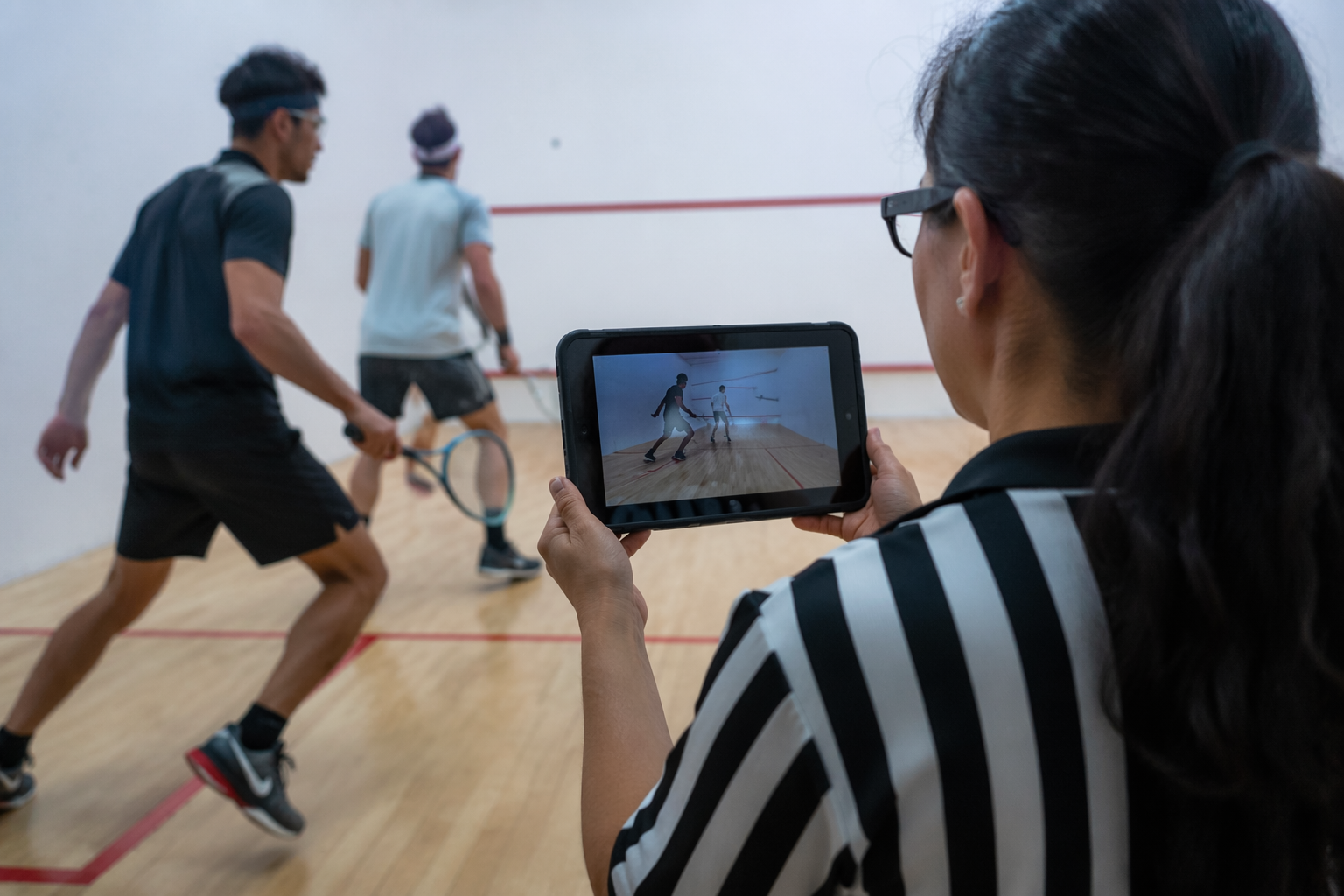
The video portion shows exactly how racquetball trains judgment instead of memorization. In 23 of the 25 clips, the candidate has to make a call and then answer two follow-up questions. Two additional clips focus on line judges and require three questions, which broadens the test beyond the referee’s primary rulings and into the details that support clean match administration.
Some clips contain no infraction at all. The test asks candidates to recognize when nothing illegal happened and let the rally stand.
The best in-match example is a screen serve. A serve that catches the receiver in traffic is not automatically a fault against the server. The referee still has to decide whether the receiver’s return attempt was actually impaired, which is exactly the kind of judgment the video clips are designed to simulate. The ruling turns on whether the player was truly prevented from making a play, not simply on contact or movement.
What the referee controls once the match starts
USA Racquetball’s officiating rules make the referee the principal official for every match. The referee is designated by the tournament director, or by an agreed-upon representative, which gives the job formal authority rather than leaving it to whoever is available courtside. A non-certified referee may be removed from a match under specified conditions.

That authority stretches beyond ordinary scoring disputes. In all sanctioned tournaments, the referee and tournament director can forfeit a match if a player or team’s conduct is considered detrimental to the tournament and the game. Officiating is also part of maintaining order when a match gets heated or behavior threatens the event itself.
Certified referees also serve a practical role for tournament directors who need help interpreting and applying the rules. In a busy draw, with age-group matches, local league play, and national events all running under the same rulebook, that support can keep the tournament moving and reduce the kind of confusion that leads to prolonged arguments between points.
Why racquetball needs trained judgment on hinders, avoidables, and contact
Racquetball’s speed shapes officiating. Hinders can happen in a blink when one player cuts across the court and the other has only a fraction of a second to swing. Avoidable hinders demand an even sharper read, because the referee has to decide whether the obstruction was a normal part of play or something a player could have avoided.
The certification ladder is built for those situations. A one-hour clinic can teach the rules, but the written test and video clips force candidates to apply them when the ball is moving fast and the players are crowded into the same corner. In a rally where a front-court player clears late and the trailing player cannot finish a swing, the official has to separate legal contact from a hindrance and decide whether the action changed the outcome of the point.
Safety and contact judgments are just as important. Racquetball is a close-quarters game, and the referee has to weigh whether a player’s movement created unnecessary risk, whether a swing was safe, and whether contact crossed the line from incidental to illegal.
How the program evolved into a national standard
The program became the national standard in 2005, when the U.S. Racquetball Association accepted the North Carolina Racquetball Association’s revised version and distributed it to the states. That gave the sport a shared referee structure instead of a patchwork of local habits.
The test was updated again in October 2023 to reflect recent rules revisions.