USA Racquetball rules build accessibility into wheelchair and impaired play
USA Racquetball’s rulebook makes a clear statement before a serve is ever struck: access is part of the sport’s architecture. Wheelchair racquetball, visually impaired racquetball and hearing impaired racquetball each have their own sections in the official rules, and the online version is presented as the latest version of those rules, with changes to Sections 1 through 10 tied to published rule-change procedures.
Accessibility built into the rulebook
The table of contents tells the story at a glance. The sport’s core sections on The Game, Courts and Equipment, Play Regulations and Doubles sit alongside Multi-Bounce, Outdoor Racquetball and the adaptive sections for wheelchair, visually impaired and hearing impaired play. That placement matters because it treats adaptive competition as part of the normal operating manual for the sport, not as a separate exhibition tucked off to the side.
For clubs, tournament directors and families, that structure changes the way racquetball can grow. A rulebook that already accounts for different bodies and sensory needs gives organizers a ready-made framework for broader draws, cleaner event planning and more entry points for new players. It also means the sport’s accessibility story is written into governance, not left to improvisation at a local level.
Wheelchair racquetball rewires the geometry without changing the game
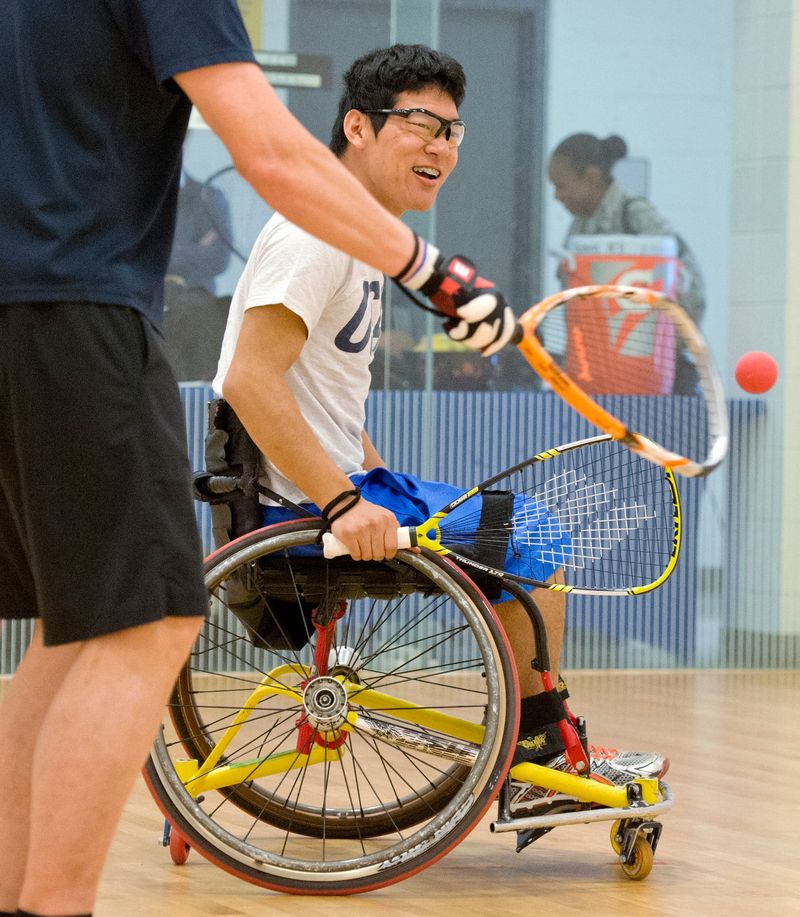
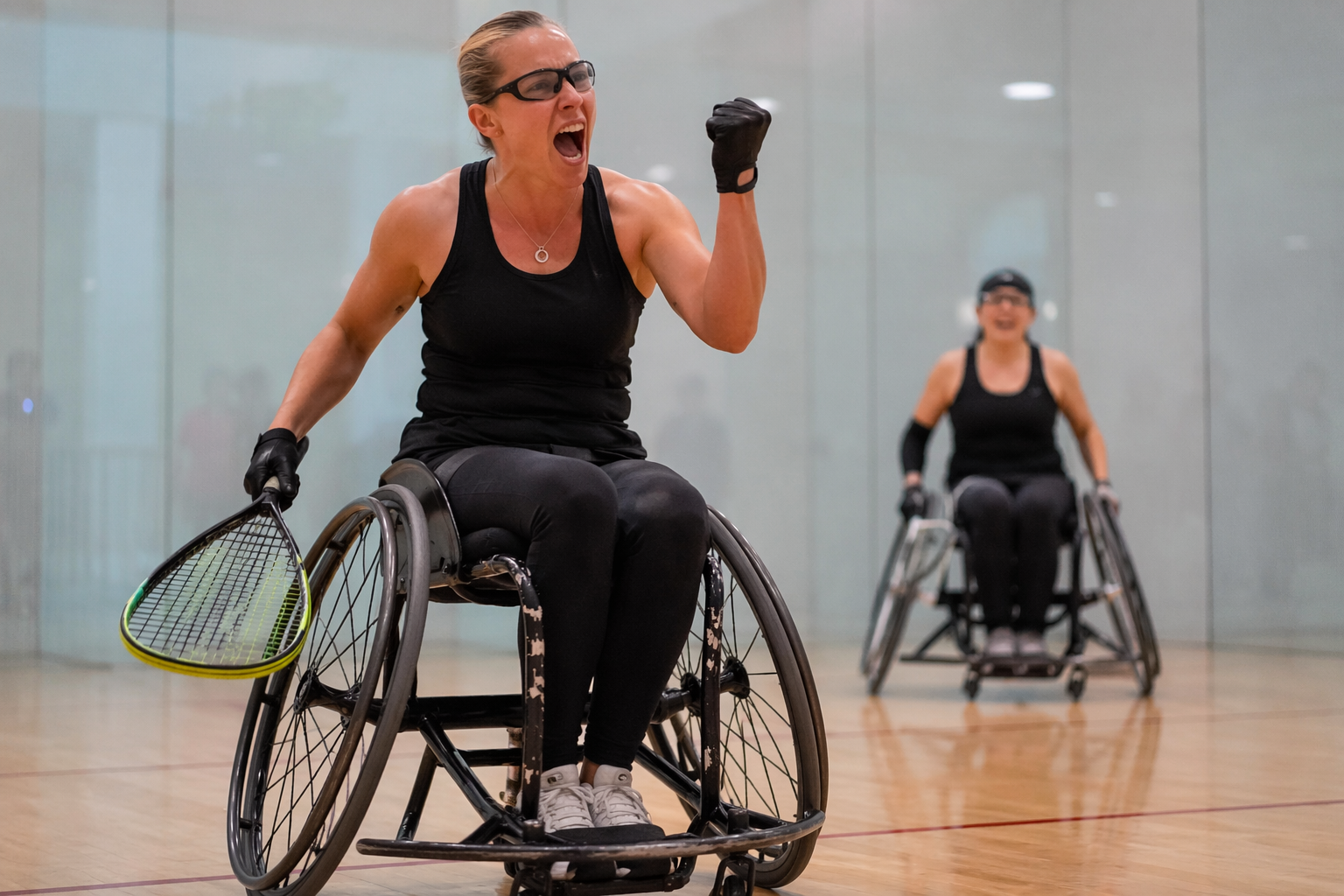
Wheelchair racquetball keeps the standard rules in place unless the wheelchair section specifically modifies them. In practice, that means the game still looks and feels like racquetball, but key definitions are adjusted to match a seated athlete’s movement and striking position. References to feet or standing are reinterpreted around the rear wheels of the chair, body contact includes the chair itself, and the standard double-bounce concept becomes a three-bounce standard.
USA Racquetball also gives the division a full competitive ladder. The listed wheelchair divisions include novice, intermediate, open, multi-bounce and junior, which creates a path from entry level play to championship-level competition. The equipment rules are just as concrete: black tires are disallowed if they can mark the court, and a wheelchair, prosthesis or assistive device malfunction can trigger a maintenance delay of up to five minutes.
The history behind that structure is already established. USA Racquetball’s record books list wheelchair national singles champions from at least 1982 onward, with names such as Jim Leatherman, Chip Parmelly, Gary Baker, Rick Slaughter, Donna Cline, Jeannie Nicklos, Stacey Norman, Tammy Riggs, Terry Rogers, Raymond Bierner, Mike Coulter and Joshua Jones. That is not the record of a novelty division. It is a long-running competitive lane with its own champions and its own continuity.
Visually impaired play is built on measurable standards
The visually impaired section is equally precise, and that precision is what makes it usable. Eligibility begins with objective thresholds: a player’s visual acuity must not be better than 20/200 with the best practical eye correction, or the player’s field of vision must not be better than 20 degrees. USA Racquetball further defines B1 as totally blind to light perception, B2 as able to see hand movement up to 20/600 corrected, and B3 as 20/600 to 20/200 corrected.
The on-court rules change the rhythm of play in a way that is specific to the division. Players get extra latitude on returns of serve and on subsequent shots, including multiple attempts to strike the ball until it has been touched, stopped bouncing or passed the short line after a back-wall rebound. The blast rule adds another distinct element: if the ball caroms from the front wall to the back wall on the fly, the player can retrieve it from anywhere on court while it is still bouncing and untouched.
That combination of eligibility standards and live-ball adjustments shows how the division works as sport, not merely accommodation. The rules do not freeze play; they preserve competition by reshaping timing, spacing and recovery in ways the court can absorb.
Hearing impaired racquetball uses a clear eligibility line
The hearing impaired section follows the same logic. USA Racquetball sets eligibility at a hearing loss of 55 dB or more in the better ear, a threshold that is easy to apply and hard to confuse. In the organization’s online index, the category is labeled Deaf Racquetball, which matches the terminology used in the governing document while keeping the eligibility standard plainly measurable.
That clarity matters for event planning. When eligibility is defined by a number rather than by guesswork, directors can classify players quickly and consistently. It also makes the division easier to explain to families and first-time entrants, who do not need to decode a subjective label before understanding whether a player belongs in the field.
Military racquetball shows the rules at work in the real world
USA Racquetball’s Military Racquetball Federation and Rehabilitation Racquetball Clinics make the accessibility framework tangible. The program focuses on wounded warriors with PTSD, TBI, amputations and wheelchair use, and the organization says the Military Racquetball Federation partnered with the Department of Veterans Affairs and the Paralyzed Veterans of America at the 36th National Veterans Wheelchair Games in Salt Lake City, where hundreds of wheelchair athletes were introduced to racquetball.
The clinic model extends beyond a one-day demonstration. USA Racquetball says MACS clinics run for eight weeks, and in 2023 eight adaptive players from Las Vegas and Phoenix VA programs competed in round robin doubles at the 3WallBall World Championships. A 2022 event brought five veterans from a weekly Las Vegas clinic and three from Phoenix, with flights donated by Allegiant Airlines and volunteer support helping the trip happen.
That is the clearest business case for accessibility in the sport. A rulebook that supports wheelchair, vision and hearing divisions gives racquetball more ways to create participants, not fewer. It gives clubs a wider base to recruit from, tournament directors a deeper pool to build from and families a sport whose written rules already make room for different bodies, different senses and the same competitive stake: getting the ball to the front wall and keeping the rally alive.
A long record of codification
Racquetball’s adaptive framework sits inside a sport that has been documenting itself for decades. USA Racquetball’s history page says the first Racquetball magazine was published in November 1972, and it references the first official International Racquetball Association championships in 1969. Its Hall of Fame also points back to foundational figures such as Joe Sobek, Bud Muehleisen, Jack Hughes and Hank Marcus.
That long paper trail helps explain why the adaptive sections fit so naturally. Racquetball has never been a loose, informal game in the corners of a gym. It has been a codified sport for generations, and its wheelchair, visually impaired and hearing impaired rules show that accessibility was built into that code, not added as an afterthought.