USHL history traced through decades of league name changes

The modern USHL did not spring up in 1979 like a brand-new circuit. It was the latest form of a league family that had been shifting through names, markets, and competitive levels since 1947, and that history still shapes how fans understand junior hockey today. The cleanest way to read it is as a lineage story: one that starts in the Upper Midwest, runs through several league identities, and lands in the Tier I model that defines the USHL now.
The name trail that built the league
Elite Prospects lays out the clearest naming chain for the league’s pre-1979 life. The history runs from the American Amateur Hockey League from 1947 to 1952, to the Central Hockey League in 1952-53, to the Minnesota Hockey League from 1953 to 1955, to the U.S. Central Hockey League from 1955 to 1961, and then to USHL-Sr. from 1961 to the present. That sequence matters because it shows continuity without pretending the league stayed the same in every era. The name changed, but the league’s regional footprint and developmental role kept evolving in the same general corridor.
HockeyDB reinforces that break point by splitting the record into two distinct histories, one for 1947-1979 and another for 1979-2026. That is more than a database convenience. It marks 1979 as the hinge between an older version of the league and the modern USHL that fans track alongside NCAA commitments and NHL draft boards.
Why 1979 changed the frame

The 2026 USHL video transcript says the modern USHL was formed in 1979 and traces its lineage back to 1947. That is the key to the whole story. The league did not abandon its past in 1979, but it did enter a new era that separated the older semi-professional and shifting-jurisdiction years from the junior model fans know now.
That shift also matches the way the league is understood inside American hockey’s development ladder. USA Hockey says junior hockey is built for players ages 16-to-20, and it currently oversees three junior leagues: the USHL, the North American Hockey League, and the North American 3 Hockey League. Within that structure, the USHL stands alone as the only Tier I junior hockey league in the United States. That makes its history bigger than a string of old team names. It is part of the country’s top developmental lane, which is why the league’s past still matters every time a prospect breaks out in the present.
Teams that bridge the old league and the modern one
The league’s transition is easiest to see in the franchise histories that overlap both eras. HockeyDB lists the Sioux City Musketeers as a semi-professional USHL team from 1972 to 1979, then as a U.S. Junior A USHL team from 1979 to 2026. That one franchise tells you almost everything about the transition: same market, same league identity, different competitive level and developmental purpose once the modern era began.
The Green Bay Bobcats show the same kind of bridge. HockeyDB lists them as a semi-professional USHL team from 1961 to 1979. Green Bay’s presence across that stretch is another clue that the league’s old identity was rooted in Midwest hockey cities that could support junior and semi-professional play long before the Tier I structure hardened into place. These teams were not just entries in a ledger. They were the living handoff from one version of the league to the next.

A snapshot from the pre-1979 league
The 1975-76 USHL season page on Wikipedia gives a useful snapshot of the older league at work. That season featured eight teams, and the Green Bay Bobcats finished as champions. The number is small enough to feel almost intimate compared with modern junior footprints, but that is exactly why it matters. It shows a league that was still compact, still regional, and still operating in a form that had not yet fully become the modern junior pipeline.
Read alongside the naming history, the 1975-76 season makes 1979 feel less like an arbitrary date and more like a structural reset. The league existed before the modern model was locked in, and the record shows both the continuity and the break. The USHL history pages on HockeyDB preserve that divide for a reason.
The modern USHL keeps expanding without losing the old map
The league’s current footprint is still changing. An ESPN report in 2026 said the USHL announced expansion plans to add Tier I junior teams in California, Nevada, and Arizona. That is a sharp contrast to the older Upper Midwest-centered history, but it does not erase it. Instead, it shows how a league with Midwest roots can carry its developmental identity into new markets without losing the Tier I label that makes it distinct.
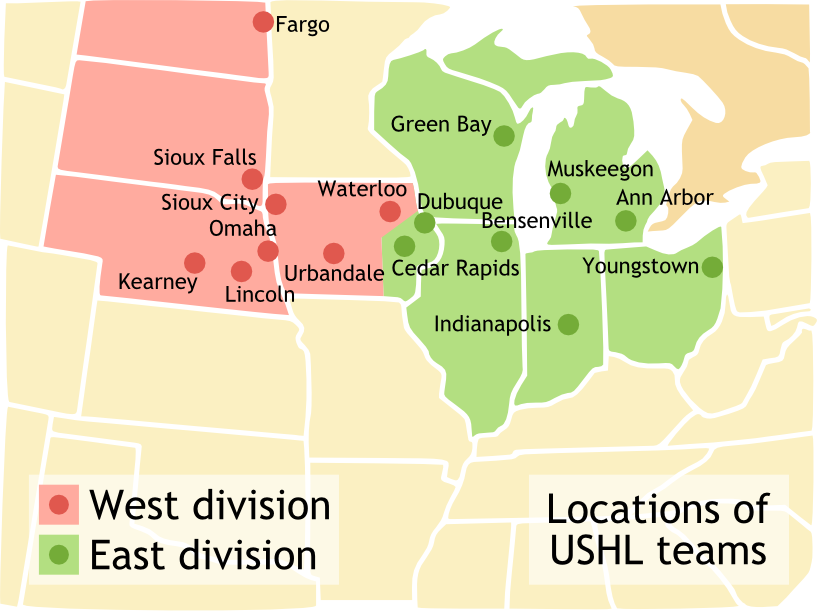
That tension is the thread running through the USHL’s story. The league family moved from the American Amateur Hockey League to the Central Hockey League, to the Minnesota Hockey League, to the U.S. Central Hockey League, and then into the modern USHL era. The markets changed, the sanctioning and level changed, and the record-keeping changed with them. What carried forward was a league built around junior hockey’s age range, its developmental purpose, and a geography that started in the Upper Midwest before reaching much farther west.
What fans should take from the history
The biggest mistake in talking about the USHL is treating 1979 as a birthdate. It was a dividing line, not a starting gun. The league’s identity came from decades of earlier circuits, from teams like Sioux City and Green Bay that bridged eras, and from a long record trail that makes the modern USHL look less like a reinvention than a refined continuation.
That is why the league still feels rooted even as it expands. The name on the jersey may be current, but the structure behind it reaches back to 1947, and the modern USHL still carries that old map inside its new one.
Sources
- [1]hockeydb.com
- [2]usahockey.com
- [3]eliteprospects.com
- [4]en.wikipedia.org
- [5]youtube.com
- [6]espn.com