USL Championship began with 2011 merger to stabilize pro soccer
The USL Championship’s most important play happened before the first kick. United Soccer League merged its USL First Division and USL Second Division into USL Pro after a September 8, 2010 announcement, creating one competition for the 2011 season and answering a fractured lower-division landscape with a single, sturdier structure.
The merger that reset the lower division
This was not a cosmetic rebrand. It was a survival move in a market where the lower tiers of U.S. soccer were unstable, and where some clubs were already peeling away to help form the North American Soccer League in 2011. By folding two divisions into one, USL reduced fragmentation, simplified the business model, and gave owners a clearer route to keep clubs alive season after season.
The first USL Pro campaign showed how carefully the league was built. It opened with 12 teams split into two six-team divisions, a compact footprint that made travel, scheduling, and costs more manageable than a sprawling national setup would have been. That modest launch mattered because it gave the league room to grow without asking clubs to carry the burden of instant scale.
Founding clubs gave the new league real weight
The original field also came with something money cannot manufacture quickly: continuity. Charleston Battery, Harrisburg City Islanders, Pittsburgh Riverhounds SC, Richmond Kickers, and Rochester Rhinos were among the founding members, and those five longtime clubs represented more than 100 years of operation combined. In a sport where lower-division identities can vanish overnight, that kind of institutional memory gave the new league instant legitimacy.
The first match on April 2, 2011 at City Stadium in Richmond, Virginia, offered the league its first on-field marker, and Stanley Nyazamba scored the first goal in league history. Those details matter because they show the merger was not just an office decision in a league headquarters. It became a live competition rooted in existing soccer communities, with Richmond, Pittsburgh, Charleston, Harrisburg, and Rochester providing a bridge from the old structure to the new one.
Division II status turned stability into credibility
The next breakthrough came in January 2017, when the U.S. Soccer Federation granted the league provisional Division II status beginning with the 2017 season after a thorough application review. That recognition changed the conversation around the league because it confirmed that USL had built enough ownership depth, operating standards, and institutional structure to stand as the country’s second division.
U.S. Soccer added another layer in 2018 by saying USL had made substantial progress toward full compliance with Professional League Standards. That matters in practical terms: sanctioning is not just a label, it is a test of whether a league can support credible competition, stable clubs, and a reliable schedule. Once USL cleared that bar, the Championship stopped looking like a patchwork of independent clubs and started looking like a professional ecosystem.
Why the merger still shapes the championship today
The scale of the league now shows how far that stabilization strategy traveled. USL Championship’s official about page says the league has more than 24 current members, and USL says it now oversees multiple men’s and women’s leagues and more than 200 clubs across its membership. That growth did not happen by accident; it grew out of a model that favored consolidation, order, and survivability before ambition.
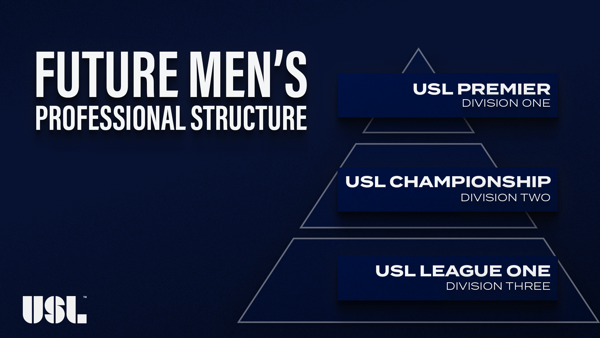
That is also why the Championship now functions as a true Division II backbone in the American soccer pyramid. The league’s later growth, along with USL’s broader talk of a future Division One men’s league and promotion and relegation, frames the Championship as the middle rung in a deliberately built ladder rather than a standalone circuit. The 2011 merger gave the league room to survive, the 2017 sanction gave it credibility, and the expansion that followed turned it into one of the most durable platforms in North American pro soccer.
Sources
- [1]uslchampionship.com
- [2]uslsoccer.com
- [3]en.wikipedia.org
- [4]liquisearch.com
- [5]thesoccerera.com
- [6]ussoccer.com