Vertical stack vs horizontal stack, how ultimate offense really works
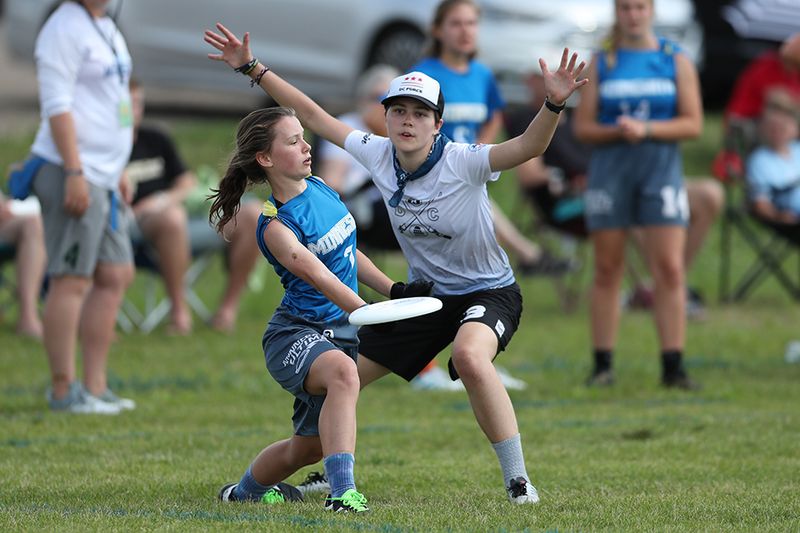
One disc, seven players, and a stack shape decide who has room to cut. Vertical stack and horizontal stack are the sport’s two most popular offensive strategies, and that choice is never just cosmetic. It determines spacing, cutting lanes, reset structure, and whether a team is trying to win with isolation, width, or a fast blend of both.
What each stack is trying to solve
At the simplest level, both systems answer the same problem: how do you create open grass when every defender can see the whole field? Ultimate allows advancement only by passing and scoring only by catching in the opponent’s end zone. Within that structure, handlers and cutters have to coordinate the geometry of the point, and the stack is the shape that makes that coordination possible.
Vertical stack lines cutters up in a single lane downfield. That gives the offense clearer isolation cuts and makes timing easier to teach, because each cutter knows where the lane begins and ends. Horizontal stack spreads cutters across the width of the field, opening more simultaneous options and forcing the defense to defend width as well as depth.
Why vertical stack still works
Dan Heijmen says vertical stack is true to its name because it attacks the field vertically. That matters most when a team is trying to move upwind, where shorter, cleaner throws and well-timed cuts often travel better than ambitious floaters. In that setup, a clean under cut, a dump to the handler, and a continuation up the sideline can feel more controllable than a wide-open structure that still needs to be organized.
Vertical also rewards players who understand timing. A cutter has to leave on the right count, clear on time, and trust that the next lane will open only after the previous cut is finished.
The reset structure is the hidden backbone of vertical offense. Ron Kubalanza warns that a thrower should always have at least four options, and vertical is hard to design without two dumps. If the dump-swing cycle breaks, the whole stack can feel trapped, especially when the defense forces the disc to the sideline and squeezes the space around the mark.
Why horizontal stack changed the picture
Horizontal stack became much more popular over the last decade, at the expense of the previously ubiquitous vertical stack offense. Teams adopted it at all levels as an initiation offense against pressure defenses, a shift USA Ultimate’s archived Huddle material called a new paradigm. Horizontal does not just give cutters more room; it changes the first decision of the point.
In a horizontal set, cutters are closer to the disc and spread across the width of the field, which can give the thrower more immediate lanes. Horizontal can present four lanes rather than two, and that extra width makes the sideline play differently. A cutter can attack across the mark, not only straight downfield, which opens break-side motion that can stress a defense that is trying to sit on the force.

Horizontal also changes the feel of a possession. Instead of one clean isolation lane, there are more simultaneous choices, so the offense has to read spacing constantly. That can make the structure more dynamic, but it also means the group has to stay disciplined about spacing or the middle of the field collapses before the thrower can exploit it.
Where both systems break down
The sideline is where elegant systems get messy. In horizontal offense, the sideline can reduce the number of viable options because the width that looked so useful in the middle of the field gets cut off. In vertical offense, the sideline can be an advantage at first, because the stack compresses the action and creates a clearer lane, but once the defense squeezes the space down, the same sideline can become a trap.
Wind changes the equation again. A Huddle contributor called wind an “8th man” for the defense against vertical offense, and another said that in heavy wind, receivers closer to the thrower become more valuable. That is why a possession in high wind often looks conservative at first: a short under to a handler, a quick dump, and another reset before the offense tries to attack space. Vertical can survive that environment, but only if the team keeps the dumps alive and does not get stuck looking for a hero throw.
Pressure defenses are the other big equalizer. Many teams now use horizontal stack as an initiation look specifically because of pressure defense at all levels.
What a point looks like in each system
A vertical possession often begins with one cutter clearing out and another attacking the open lane. If that first cut is denied, the thrower goes to a dump, then looks for a continuation or a swing once the defense shifts.
A horizontal possession often looks more like a series of quick reads. The thrower can choose between multiple cutters moving in different directions, including cuts across the mark, and that makes the middle of the field a live target. If the defense poaches into the lane or switches aggressively, the offense has to re-space immediately or the whole width advantage disappears.
Why modern offenses blur the line
Few teams live in only one shape. Horizontal stack is often used as an initiation set rather than a full-point identity, and teams may flow into vertical spacing after the first few throws. The same group might start wide, hit a reset, then collapse into a vertical lane for an isolation cut once the defense has been stretched.