Viggo Bjorck leads thin 2026 NHL Draft center class
The 2026 draft’s center board has a simple problem: after the first handful of names, the drop-off gets steep fast. That is why Viggo Bjorck is sitting at the top of the conversation, because clubs do not just see a skilled teenager from Sweden, they see a player who might force the issue in a class where true middle-of-the-ice options are scarce. With the draft set for June 26-27 in Buffalo, the fight over which pivots can actually stay at center is becoming one of the most important debates on the board.
Why center scarcity matters
This is not a draft where teams can wait around and pick a center later. The position is thin enough that value may override pure comfort, and that is exactly how players get pushed up boards in June. Recent broad draft coverage, including a 13-scout survey, has underscored how much disagreement still exists in this class, which only makes the center conversation louder.
The key distinction is projection. Some forwards are listed as centers because they take faceoffs or have played there at youth levels, but NHL teams are really asking a harder question: who can survive the nightly grind down the middle against bigger, smarter competition? In this class, that answer appears to separate Bjorck, Caleb Malhotra and Tynan Lawrence from the rest of the pack.
Viggo Bjorck: the most complete bet
Bjorck gets the top-center billing because his game travels. Born March 12, 2008, in Stockholm, he was listed at 5-foot-10 and 172 pounds in a 2026 draft profile, and he spent 2025-26 with Djurgardens IF in both the SHL and U20 Nationell. That matters more than the frame on paper, because he has already been tested against older competition and has not looked out of place.
What separates him is the combination of two-way responsibility and offensive processing. Public scouting reports have framed him as an undersized but highly intelligent forward who can handle pro competition and contribute in playoff settings, which is exactly the kind of profile that can beat out bigger names when a team believes the center class is shallow. NHL Central Scouting ranked him fifth among international skaters, and that kind of placement tells you he is not just surviving on skill buzz alone.
There is also a built-in wrinkle with Bjorck: he is a right-shot center who can also play right wing. That flexibility is useful, but it also explains the debate around him. If a team believes he can hold the middle full-time, he becomes a premium asset. If the room thinks he is more of a winger long term, the center value gets discounted fast. In a class this thin, that distinction can move a player several spots on draft night.
Caleb Malhotra: size, structure and a real center frame
If Bjorck is the skill-and-processing bet, Caleb Malhotra is the cleaner structural fit. Born June 2, 2008, in Toronto, he is listed at 6-foot-2 and 183 pounds, shoots left, and is committed to Boston University. NHL Central Scouting ranked him fifth among North American skaters, and that places him right in the heart of the first-round conversation.
NHL.com described him as a “complete player,” and that label tracks with what has made him so appealing in Brantford. He was making waves in his rookie OHL season, and the broader appeal is obvious: he has the frame, the two-way habits and the family background of a player who understands what center ice demands. Manny Malhotra, his father, was a former NHL center and is now an AHL head coach, so the bloodline is not just a fun footnote. It is part of why scouts trust the hockey sense and the maturity.
Malhotra feels like the safest true-center projection among the names at the top of the class. He does not need a position change to create value, and that is important in a year when clubs may be hunting for a player who can anchor a line rather than merely fill a spot. If Bjorck is the more dynamic debate, Malhotra is the one who looks built to stay down the middle.
Tynan Lawrence: the USHL proof point
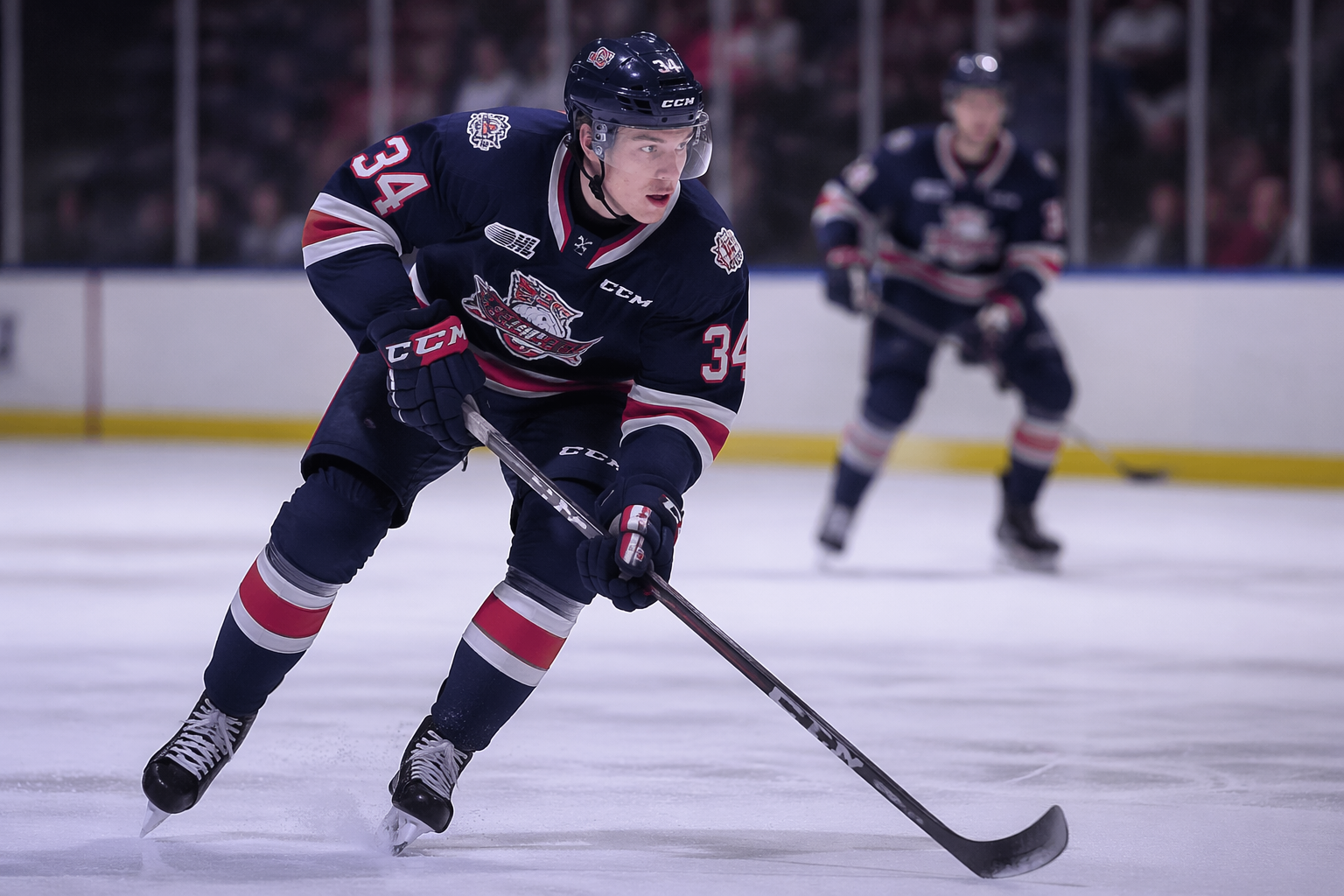
For USHL readers, Tynan Lawrence is the most recognizable piece of the puzzle because his path runs directly through the league. Born Aug. 3, 2008, in Fredericton, New Brunswick, he is listed at 6 feet and 185 pounds, shoots left, and has already shown enough offense to stay in first-round conversations even after moving on to Boston University for the second half of the 2025-26 season. NHL.com placed him on its players-to-watch list as an A-rated skater, which fits a player whose pace jumps off the page.
The USHL production is what makes him hard to ignore. He had 17 points, 10 goals and seven assists, in 13 games before leaving for Boston University, and before that he tore through the league with Muskegon by posting 25 goals and 54 points in 56 games. He also helped the Lumberjacks win the league title and took playoff MVP honors. That is not just good junior production, it is the kind of run that reminds teams why they chase speed and finishing from the middle of the ice.
Lawrence also shows how the USHL can elevate a player’s draft case even after he changes leagues. His season with Muskegon gave scouts a long enough look to trust the scoring, the pace and the playoff impact, and the move to college did not erase any of it. If a team is searching for a center who can create offense and keep up with the speed of NHL-paced hockey, Lawrence stays in the conversation for a reason.
Center projection versus wing insurance
This is where the class gets interesting. Bjorck, Malhotra and Lawrence are all listed as centers, but they do not all solve the same problem. Malhotra looks like the most natural middleman because of his size and structure. Lawrence brings the offensive punch and the USHL resume that can make a team believe in top-six upside. Bjorck is the hardest to pin down, which is exactly why some teams will love him and others will hesitate.
The wing question matters more than people admit. In a weak center class, a prospect who can truly stay at center has extra value because he saves a team from having to shop for that role later. A prospect who may eventually shift to wing can still be useful, but that is not the same commodity. The draft room is going to separate those two outcomes quickly, and Bjorck’s center-right wing label makes him the most obvious test case.
What the board is really telling teams
The bigger lesson is that scarcity changes behavior. When the center pool is thin, teams do not just draft talent, they draft certainty, or at least the closest thing to it. That is why Bjorck’s mix of intelligence and pro comfort, Malhotra’s complete-game profile and Lawrence’s USHL scoring résumé all carry extra weight.
This class is still being argued over by scouts, and that uncertainty is not a flaw, it is the story. The clubs that value a true center will probably push harder and earlier than usual, while the ones that see wing risk will wait and hope the board breaks their way. In a year like this, the center line is not just a position group. It is the draft’s leverage point.
Sources
- [1]thehockeynews.com
- [2]sports.yahoo.com
- [3]nytimes.com
- [4]thehockeywriters.com
- [5]nhl.com
- [6]dailyfaceoff.com