WDBF rulebook standardizes dodgeball with precise court and ball specs
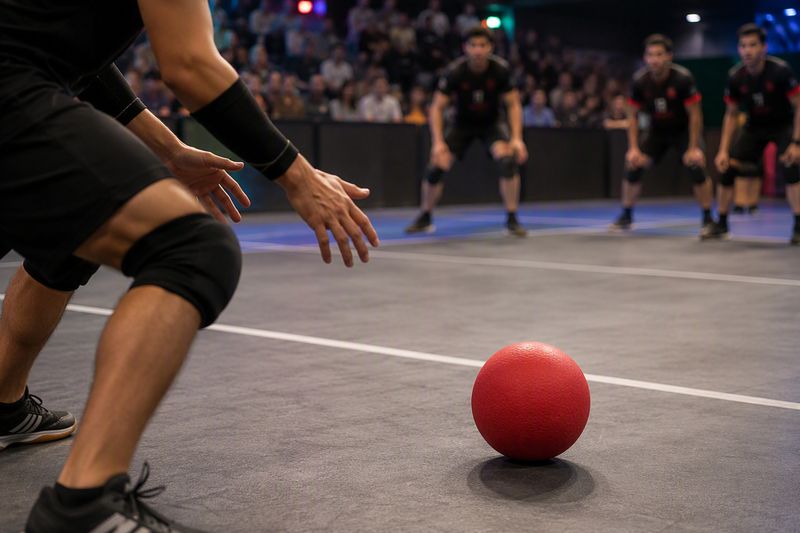
An elite WDBF dodgeball match is played on an 18-meter by 9-meter court, with standardized foam and cloth formats and a 30-second reset between sets. The international game also uses free space around the court and a visible timing device to keep the action moving.
The court does the first piece of coaching
The WDBF playing area is a rectangle surrounded by free space. In practice it controls how players spread out, how quickly defenders can close space, and how much room throwers have to find angles. When the attack line and boundary markings are fixed, the opening seconds stop being improvisation and become a measured sprint into specific lanes.
Dodgeball is often won before a long rally ever develops. The short distance between the center line and the attack line compresses the first exchange, so teams have to decide immediately whether to rush, fan out, or protect against a quick elimination. In a looser gym-class version, the court can be whatever the room allows; in WDBF play, the rectangle sets the pace before the whistle even blows.
Foam and cloth are not treated like the same game
The 2024 WDBF rulebook separates foam and cloth formats and gives each one its own standards. The sport is not just one universal game with different balls, but a set of carefully defined versions that share a common structure while playing differently in practice. Standardization keeps a tournament in one country from becoming a different sport the moment it crosses a border.
The foam-ball specifications show how exact the system is. The published 2024 rules reference a 17.8-centimeter, or 7-inch, ball diameter, and the rulebook also specifies a polyurethane-coated construction.
A clean hit in one country should mean the same thing in another, and a legal ball should feel the same in a World Championship pool play match as it does in a domestic final.
The clock is part of the strategy, not just the scoreboard
WDBF’s 2024 rule changes did more than tidy up language. The federation moved both teams’ areas to the same side of the court so one timing and scoring device can be used and both teams can see it, a small logistical change that makes the match easier to run and easier to follow. It also standardized the reset time between sets to 30 seconds, giving broadcast crews, officials, and players a predictable rhythm.
Instead of chaos between points, there is a clear reset window, a visible score device, and a cadence that turns each set into a sequence of bursts and pauses.
The rule changes were also made using feedback from the dodgeball community, and the federation aimed to clarify penalties for violations more explicitly. Clearer penalties reduce argument, speed up restarts, and keep the focus on execution.
A global rulebook for a global sport
The WDBF was formed in 2012 and is headquartered in Edmonton, Canada. The federation is active on six continents and in more than two dozen countries. A standardized court, ball, and timing structure become the common language that holds competition together across multiple continents and national systems.
That scale was on display at the 2024 World Championships. WDBF counted 1,400 participants from 36 countries across all six continents. On October 8, 2023, the federation called the event the biggest in the sport’s history.
Why multiple rule families still matter
WDBF is not the only body shaping dodgeball’s formal game. The World Dodgeball Association’s Rules & Regulations Version 2.0.4 were used for the New York World Cup in 2018, and the European Dodgeball Federation published Rules & Regulations Version 6.1 in 2024. Dodgeball Australia recognizes rules and regulations adopted by the World Dodgeball Association and the Asian Dodgeball Federation, while USA Dodgeball maintains its own rules page and member-organization structure.
The WDBF rulebook is part of a broader push to make the sport legible across regions that have grown up with different standards, different tournament traditions, and different interpretations of what counts as a legal throw or a valid out. The modern elite game is still fast and aggressive, but the speed is now managed by measured court dimensions, defined equipment, and procedures that make a point feel the same in one country as it does in another.