Why the 7-yard blitz rule shapes flag football offenses
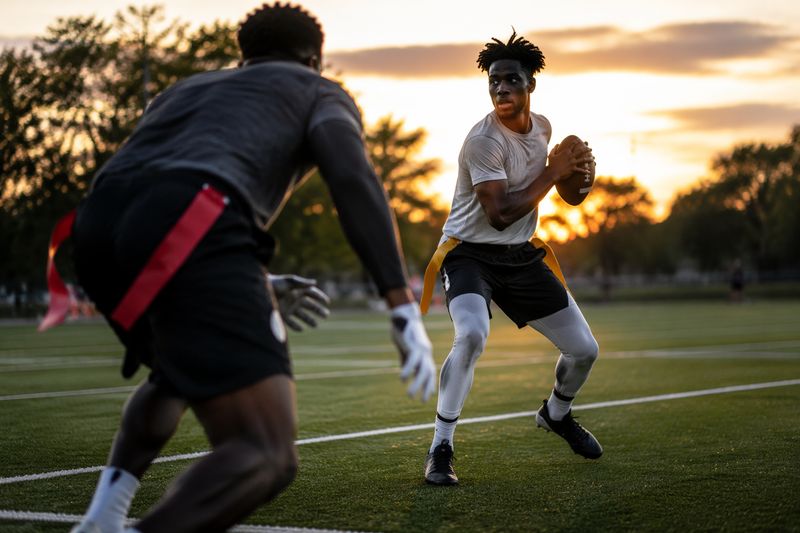
A rusher has to start at least 7 yards from the line of scrimmage in flag football. That means pressure is never random and never free. Quarterbacks can identify it before the snap, receivers have to win quickly, and offenses have to build answers into the call instead of hoping the pocket survives.
The 7-yard rush is the sport’s design problem
NFL FLAG treats that rush rule as part of the game’s core structure, not an afterthought. Its rules hub sits alongside dedicated pages for rules, positions, penalties, equipment, plays, drills, and how to play. The official flag materials also link to Spring 2025 and Spring 2026 rulebooks and tournament guidelines.
The 7-yard start gives the defense a weapon, but it also gives the offense a clock. The rusher has to declare from depth, so the quarterback can read leverage, anticipate the launch point, and get the ball out before the rush arrives.
Why blitzing is dangerous and useful at the same time
A well-timed rush can blow up a play before it develops. It forces hurried throws, narrow windows, and panic if the quarterback hesitates. But the same rush also creates space behind it, and that is where the best flag offenses make their money.
When a defender commits from 7 yards deep, someone has to occupy the area that defender just left. Offenses attack that gap with quick releases, shallow routes, and route combinations designed to punish over-aggression. The defense is trying to win with speed; the offense is trying to turn that speed into a disadvantage.
The rule also explains why flag football feels so different from tackle football. In tackle, protection schemes can absorb pressure with size and contact. In flag, the better answer is usually anticipation, spacing, and a throw that arrives before the rusher gets home.
The quick game is the first line of offense
Quick game is the simplest answer because it cuts the blitz off at the knees. Slants, outs, stick routes, and immediate underneath throws are built to beat a defender who has to cover 7 yards before the play even starts. If the ball is gone on rhythm, the rush becomes background noise.
That is why many flag teams simplify their calls. A short menu of fast concepts is easier to rep and harder to break, especially when the quarterback knows the ball has to come out now. NFL FLAG separates instruction on plays and drills, reflecting that reality: repetition matters more than exotic design when the rush clock is this short.
Timing routes matter for the same reason. A timing route is not just a route tree concept, it is a promise between quarterback and receiver about where the ball will be and when. In flag football, that timing determines whether the ball arrives before the rush.
The center is not a blocker, he is often the first answer
In NFL FLAG, the center snaps the ball and then can run out as a receiver. That detail changes the offense immediately, because the player closest to the quarterback is not stuck in place after the snap. Instead, the center can become the first quick outlet when the blitz comes fast.
That is a major part of why flag football offenses can feel overloaded in space. The center can release into the pattern, which means the defense has to account for another receiver at the exact moment the rush begins. In practical terms, the center is often the cleanest answer to pressure because the route starts before the defense fully closes the gap.
Misdirection buys the extra half-second
Misdirection matters because the rush rule makes half-seconds count. Motion, switches, and route exchanges force defenders to sort out who is going where while they are already sprinting from depth. That delay is enough for a quarterback to hit the open lane.
The best flag concepts use that delay to create the throw they want, not the one the defense wants. A switch release can drag coverage the wrong way, a moving launch point can change the sight line, and a fake to one side can clear the other. Once the rusher commits, any wasted step is expensive.
That is also why the offense does not need a huge menu. A small set of concepts, run cleanly, is often better than a long playbook that slows the snap-to-throw rhythm.
Quarterback discipline decides whether the blitz helps or hurts
The quarterback has the hardest job because the 7-yard rule makes hesitation lethal. The ball has to come out on time, and the read has to happen before the rush arrives. If the quarterback drifts, double-clutches, or waits for a route to uncover too late, the defense has already won.
That discipline shows up in more than arm talent. It means trusting the first window, understanding where the rusher started, and knowing where the immediate escape valve lives.
The same rule shows up across formats and levels
NFL FLAG is not the only place using the 7-yard idea. A published 7v7 NFL flag rulebook from Quad Indoor Sports allows rushing from a 7-yard distance marked by cones, and the National Flag Football rulebook includes a specific section titled “Rushing of the Quarterback.”
USA Football’s 2026 7’s and 5’s rulebooks push the structure even further by tying officiating to the National Team Development Program and U.S. National Team competitions. The rulebooks also say officials gain expertise for opportunities on the world’s biggest stage in Los Angeles in 2028.