Why the ceiling ball is racquetball’s most strategic shot
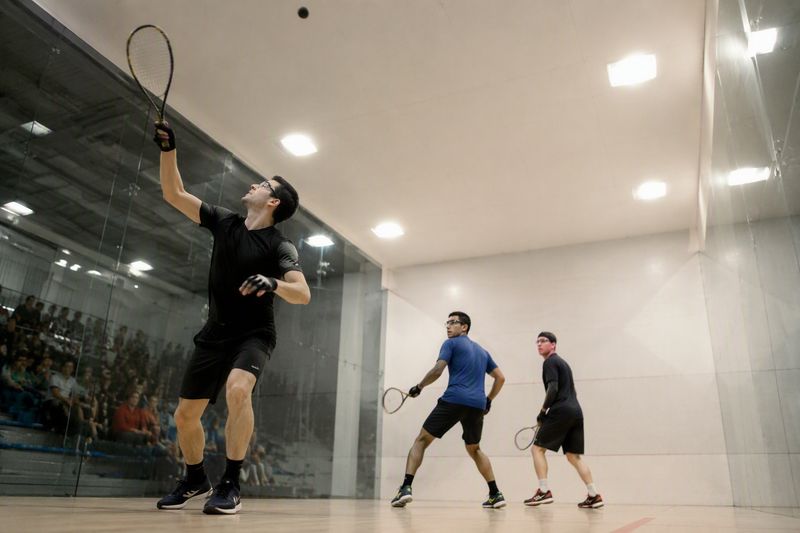
William & Mary’s racquetball teaching page calls the ceiling ball the most important single shot in the game. Racquetball has two shot types: offensive shots that finish points and defensive shots that force an opponent deep so you can take good center-court position.
Why the ceiling ball sits at the center of strategy
The ceiling ball matters because racquetball rewards position as much as power. In the University of Georgia’s open text, a complete player needs command of both offensive and defensive shots, because rallies are often won by the player who controls depth and center court rather than the player who swings first.
A January 15, 2011 instructional article on ceiling balls defined the shot’s purpose as moving an opponent out of position and creating an offensive position in center court.
What the shot is doing to the rally
The ceiling ball works because it uses the geometry of a four-wall court to force a bad reply. In William & Mary’s material, the ball strikes the ceiling about 4 to 8 feet in front of the front wall, then travels to the front wall and rebounds deep into the back court. That flight takes pace off the exchange, buys time, and pushes the other player away from the front wall.
This is why the shot is so effective when the rally speeds up. If a power shooter is driving you around the court, the ceiling ball changes the rhythm without needing a winner. Instead of trying to out-hit the pressure, you absorb it, send the ball high, and make the opponent cover extra space before they can attack again.
Where it matters most: the back corner, the pressure rally, and the reset
The ceiling ball is especially useful when you are trapped in the back corner. From there, the shot can be struck from almost anywhere on the court, but it is typically hit from the back court, where the player has been forced off the middle and needs immediate relief. A clean ceiling ball from that position does two things at once: it clears the pressure in front of you and keeps the ball deep enough to stop your opponent from taking over.
It is just as important against a hard-hitting opponent who is looking to end points early. A high, deep ceiling ball makes that player turn, retreat, and hit from a disadvantaged position, which is exactly the opposite of what a power shooter wants. In a fast-paced exchange, the shot slows the pace and gives you time to recover your stance, which is why it is often the smartest answer when the rally feels out of control.
Center court is the real prize
Racquetball strategy is built around the center of the court, and the ceiling ball is the shot that helps you get there. The 2014 video “Racquetball: Center court strategy” featured Leo Vasquez, program director of the Maverick Athletic Club in Arlington, Texas, demonstrating how to control that space. In Racquetball Lessons & Tips, the benefits of being in a ready position at center court while waiting to return serve are huge.
A racquetball court is divided into front court, mid-court, and back court: the front court runs 15 feet from the front wall to the foot fault line, mid-court covers the 10 feet between the foot fault line and the dotted safety line, and the back court is the remaining 15 feet. If the opponent is driven deep and you can step back toward the middle, you shrink their angles and make your next shot selection stronger.
What the rules and court standards tell you about the game
One version of USA Racquetball’s official rulebook went into effect on September 1, 2013 and was last updated September 30, 2015, while the International Racquetball Federation’s official rules are labeled “Official Rules 2024” and “August 2024.”
A standard racquetball court construction specifications document was approved January 19, 1983 and revised April 11, 2007. Those standards make court geometry reliable: if you know where the ball will land high on the front wall and where it will rebound, you can turn defense into position.
How to think about it in live play
The simplest way to understand the ceiling ball is to see it as a controlled retreat that creates an advantage. It is not flashy, and it is rarely the shot that gets the loudest reaction, but it often decides who gets to attack next. When the rally is messy, when you are pinned in the back corner, or when a power player is trying to speed everything up, the ceiling ball resets the point and gives you a path back to center court.