Why the lob is the key to winning padel points
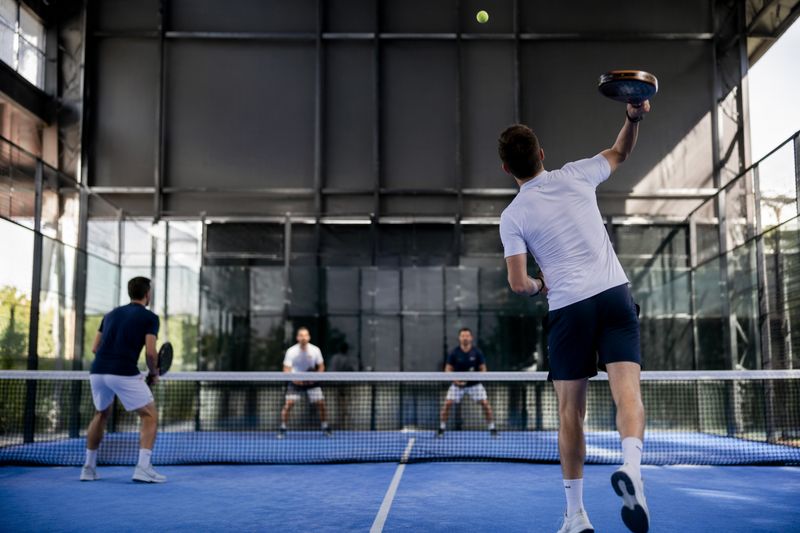
The lob changes the whole shape of a padel rally before a finishing shot ever appears. In elite padel, the point is usually won by the pair that recovers the net first, and the cleanest way back there is a high, precise lob that pushes opponents off their preferred attacking position.
The lob is the reset button
A good lob does more than lift the ball over an opponent’s head. It buys time, interrupts the net player’s attack, and creates the opening to reclaim the front of the court. That is why the best padel points often begin with defense and only later become offense, because the player who forces a retreat usually decides who controls the next exchange.
The dimensions of the game make that pattern even more important. The official FIP rules set the court at 10 by 20 metres, with a minimum height of 6 metres, and that combination rewards patience, placement, and overhead control as much as raw force. On a court built around walls and angles, a lob is not a bailout shot. It is a tactical claim on space.
The overhead sequence that follows the lob
Once the lob has moved the opposition away from the net, the next choice defines the rally. The bandeja is the control overhead, a slice-based shot used to keep the pair at net and avoid handing over a weak rebound. It is not a half-smash. It is a deliberate way to keep pressure on while staying in position for the next ball.
The víbora sits one step closer to aggression. It adds side-spin and more direct pressure, making the return harder to control and increasing the chance of an error or a floating reply. From there, the smash becomes the terminal shot, and its by-3 and by-4 variants turn the court’s walls and geometry into a point-ending weapon.
PadelMBA’s Aerial Game course places the bandeja, víbora, and smash variants out by 3 and out by 4 at the centre of the attacking toolkit, which tells you exactly how the sport should be read. These are not decorative shots for highlight reels. They are the architecture of an attack built from the lob upward.
What to watch in a rally
When a match opens up, watch for the sequence, not just the last strike. The key moments usually come in this order:
• A defensive lob that is high enough to move both opponents backward • A first overhead choice, usually the bandeja when the priority is control • A víbora when the player wants to add spin and force a weaker reply • A smash only when the geometry is right for a by-3 or by-4 finish
That framework changes the way every point looks. Instead of waiting for a thunderous winner, watch the net line, the quality of the lob, and the quality of the opponent’s recovery after the overhead. The player who stays balanced after hitting the bandeja or víbora often has already won the most important part of the exchange.
Why padel developed around this pattern
The International Padel Federation is the world governing body of the sport, and its sports department can recommend rule changes. That matters because padel has grown under a formal structure rather than through loose local variation, and the tactical language of the game has been shaped inside that framework.
FIP’s history shows how fast the sport spread. During the 1980s, it expanded beyond its early base into Brazil, Uruguay, Chile, France, the United States, and Canada. Argentina created its first national association in 1988, and in January of that same year the first Spain-Argentina international competition was played in Mar del Plata, in Buenos Aires Province. By 1997, Spain and Argentina had agreed in Barcelona to unify the rules and standardize the name pádel.
That structure helps explain why elite padel has such a recognizable rhythm. The game is not built around one spectacular swing. It is built around a repeatable sequence of positioning, recovery, and controlled overheads that can be taught, drilled, and judged.
A global sport with numbers that match the style
The scale of padel now gives this tactical pattern a worldwide audience. FIP’s World Padel Report 2024 says the sport is played in 130 countries, with almost 20,000 clubs and more than 63,000 courts around the world. The same report counts 30 million amateur players and 600,000 federated players, and says 40 percent of federated players are female.
FIP presented that report at its General Assembly in Asunción, Paraguay, on 16 May 2024. The federation also established a single official international ranking for professional men and women from 2024, working with Premier Padel and the CUPRA FIP Tour, and in agreement with the Professional Padel Association and the International Padel Players Association. That move gives the elite game a cleaner global structure, which makes the distinction between control shots and finishing shots even easier to see across tours and events.
The top level is already telling you what matters
The elite game is reinforcing the same lesson in real time. Premier Padel’s recent highlights have repeatedly shown bandejas and víboras deciding points and games, which is a useful reminder that these shots are not niche technical details. At the highest level, they are often the difference between holding the net and giving it away.
That also fits the sport’s broader institutional momentum. On Olympic Day in 2026, FIP said padel is among the most dynamic, inclusive, and fastest-growing sports in the world. FIP president Luigi Carraro attended the European Olympic Committees General Assembly in Budapest on 12 and 13 June 2026, and IOC president Thomas Bach praised him in February 2025 for helping spread padel worldwide. The message is clear: as the sport’s reach expands, the points are still being won by the same tactical chain.
Once you read padel through the lob, everything else comes into focus. The bandeja keeps control, the víbora adds pressure, and the smash finishes only when the court has already been won.
Sources
- [1]blog.padelmba.com
- [2]padelfip.com
- [3]premierpadel.com
- [4]padelmba.com