World Dodgeball Federation explains the sport’s many official formats

Dodgeball’s biggest misconception is that it is one game with a few cosmetic variations. The World Dodgeball Federation treats it as something broader: a sport with foam, cloth, rubber, beach, trampoline and digital formats, all tied together by a shared competitive core but split by equipment, surface and setting. That is why the same sport can live in a school gym, on sand, or on a trampoline court without losing its official structure.
Dodgeball is a family, not a single code
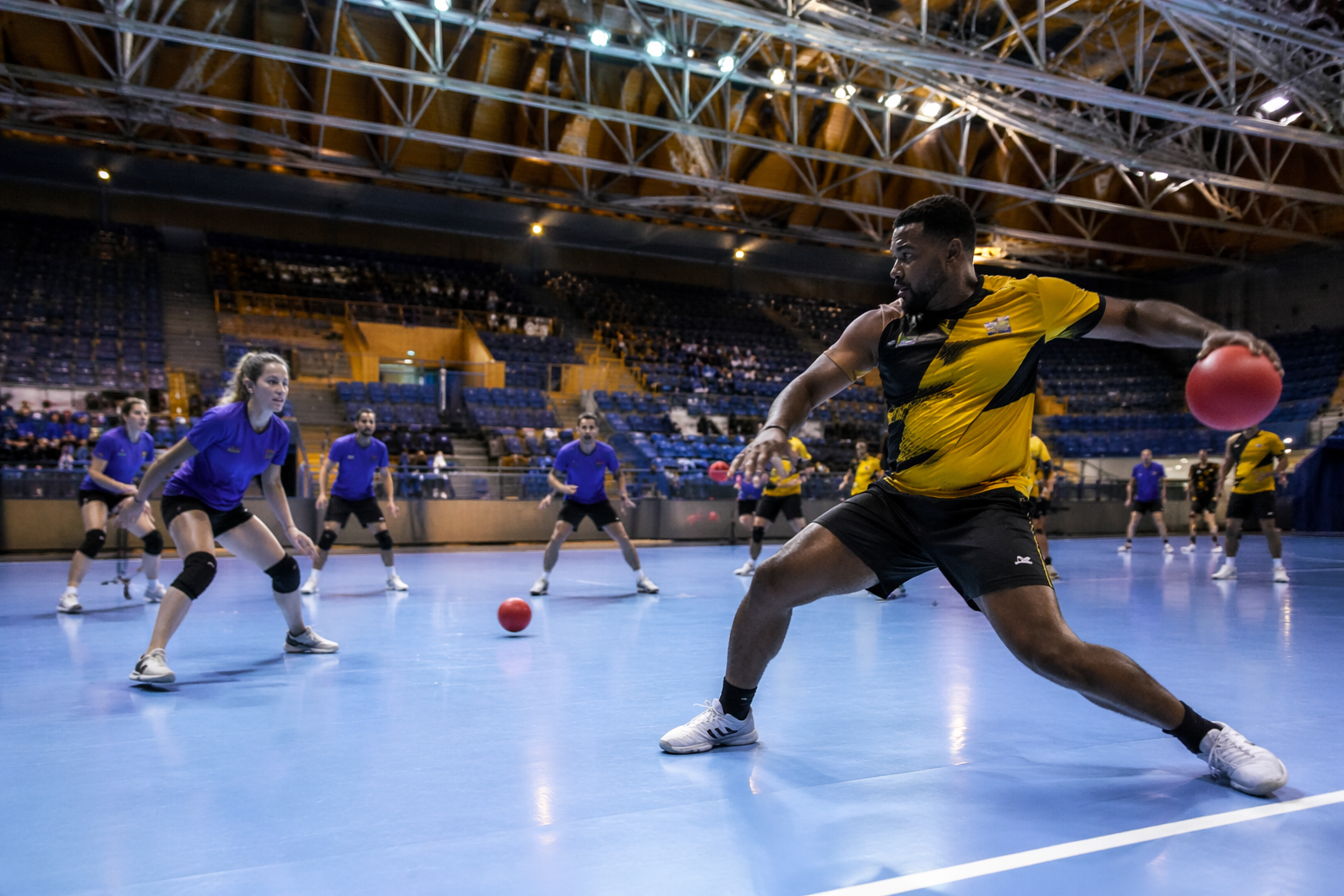
The federation’s own by-laws make the split explicit. Sanctioned events are usually played on a surface court such as wood, turf or sport flooring, on sand for beach dodgeball, or on a trampoline or other elastic surface for trampoline dodgeball. Ball types include foam, rubber and fabric, and each discipline carries its own regulations on top of the core rules.
That matters because the format is not just a branding choice. A foam-ball game on a court asks for quick reactions and clean spacing. Beach dodgeball changes everything again, because sand punishes late steps and makes recovery slower. Trampoline dodgeball turns timing and body control into the whole game, since the surface itself changes how players move, rise and land. The federation’s format list is really a map of how the sport adapts to different bodies, venues and communities.
The WDBF even extends the idea beyond the physical court by listing digital formats alongside the traditional ones. That breadth is why dodgeball travels so well: one set of rules can support wildly different settings, but only if each code is treated as its own sport within the larger family.
The surface is the strategy
Surface is not a backdrop in dodgeball. It shapes footwork, spacing, recovery and what kinds of throws and blocks players can attempt safely. On wood, turf or sport flooring, movement is sharper and more predictable, which favors quick angles and crisp transitions. On sand, the game slows down and becomes more about balance, leg strength and reading space before it closes.
Trampoline and other elastic surfaces change the rhythm again. Players are not just managing lateral movement and reaction time, they are managing lift, landing and the extra variable of bounce. That is why a beach event, a trampoline event and a cloth- or foam-ball event do not feel identical even when they belong to the same federation and follow the same competitive logic.
Accessibility also changes with the surface. An indoor court can be staged in an arena or school facility. A beach format opens the sport to coastal venues and summer festivals. A trampoline format asks for specialized infrastructure, but it creates a very different spectacle and a different kind of athlete, which helps explain why dodgeball can reach multiple audiences without pretending every version plays the same.
The rulebook is alive
The federation is not treating its rules as museum pieces. Its by-laws were created on November 10, 2019, amended on January 9, 2024 and approved by Congress on September 13, 2024. The posted rules document is the current active guide used in all WDBF-sanctioned events, which means the rules are not just written down once and left to age.
That matters in a sport with several codes, because the border between core rules and discipline-specific regulations has to stay clear. The WDBF released an updated international rules framework on May 8, 2026 after consulting athletes, referees, continental confederations, national federations and technical leaders. That kind of update tells you the sport is still being shaped by the people who actually play, officiate and organize it.
The federation was formed in July 2011, when representatives from several countries agreed to create a global body for the sport’s international development. That origin is important because it shows dodgeball did not grow into an organized international sport by accident. It was built by design, and the rules are still being maintained by the same logic.
The international calendar gives the sport weight
A sport with multiple formats still needs a center of gravity, and the World Championships provide it. The 2024 World Dodgeball Championships were held in Graz, Austria, from August 11-17, 2024, and were hosted by the Austrian Dodgeball Association. The federation said the event drew more than 1,200 participants from 123 teams, a scale that makes the championship feel less like a niche gathering and more like a serious global tournament.
That scale matters for fans because it gives the sport a reference point. The World Dodgeball Association says it works with regional governing bodies around the world to further the sport, while CSIT World Sports Games says the WDBF has a presence in more than 80 countries worldwide. Put those pieces together and dodgeball starts to look less like a local pastime and more like a sport with a real international calendar and a real governing footprint.
The next marker is already on the board. Bangkok will host the 11th WDBF Championships in 2026, which keeps the global circuit moving and confirms that the federation’s multi-code structure is not theoretical. It is the framework that lets dodgeball keep expanding without losing the competitive identity that makes each version recognizable.
What the fragmentation really means
This is the part that should change how you think about the sport. Dodgeball’s fragmentation is not a weakness to be fixed, it is the reason the game can survive in so many places at once. Foam, rubber and fabric balls produce different speeds and risks; wood, turf, sport flooring, sand and elastic surfaces produce different movement patterns; and each of those combinations attracts a slightly different player and a slightly different crowd.
British Dodgeball captures the culture side of that reality by stressing that competitive intensity cannot become cheating. That is the line the sport has to hold if it wants all of its codes to coexist under one umbrella: sharp enough to be taken seriously, broad enough to fit different venues, and structured enough to keep every version honest.