World Dodgeball Federation guidelines reveal the sport's officiating structure
Elite dodgeball only looks spontaneous until a referee steps in. The World Dodgeball Federation’s officiating guidelines make clear that matches depend on a structure built to keep play orderly, safe, and respectful, with officials managing everything from pre-match checks to sudden-death calls. In a sport where a single catch, foot fault, or disputed release can swing a set, the officiating team is not background noise. It is the system that gives the game meaning.
The officiating structure behind the whistle
The federation’s 2019 officiating guidelines read less like a sideline memo and more like an operating manual. Their table of contents runs through General Guidelines, Court Management, Official Conduct, Officiating Team, Responsibilities of a single official, Power and duties, Guideline for officials, Code of Conduct, Official’s judgment, Change of official, Referee interference, Hand Signals, Making a Call, Court positions, and On-Court Checklists. That breadth tells you how much the sport relies on repeatable process rather than improvisation.
At the center of that process is a simple mandate: match officials are responsible for ensuring all aspects of a match are conducted in an orderly, safe, and respectful manner. That includes the temperature of the match itself, but also the behavior of players, captains, coaches, ball retrievers, court managers, spectators, and other officers on the court. When a game is moving at full speed, the referee’s job is to keep the action legible in real time.
Why elite dodgeball needs procedural control
The best way to understand WDBF officiating is to think in sequences, not highlights. Officials are expected to prepare before the match, before each set, at the beginning of sudden death, when disciplinary action is needed, and at the end of the match. That checklist approach matters because dodgeball does not just generate action, it generates judgment calls, and those calls need to be made on the same rhythm every time.
This is where the sport’s hidden infrastructure shows up. A catch only matters if everyone can tell whether both feet stayed legal, whether the ball was controlled, and whether the signal came from the right angle. A boundary touch only matters if the official’s positioning lets the call be made instantly. A simultaneous throw only matters if the crew is close enough to separate release timing from reaction timing. Without that procedural backbone, the sport slips back toward chaos.
What the official crew looks like
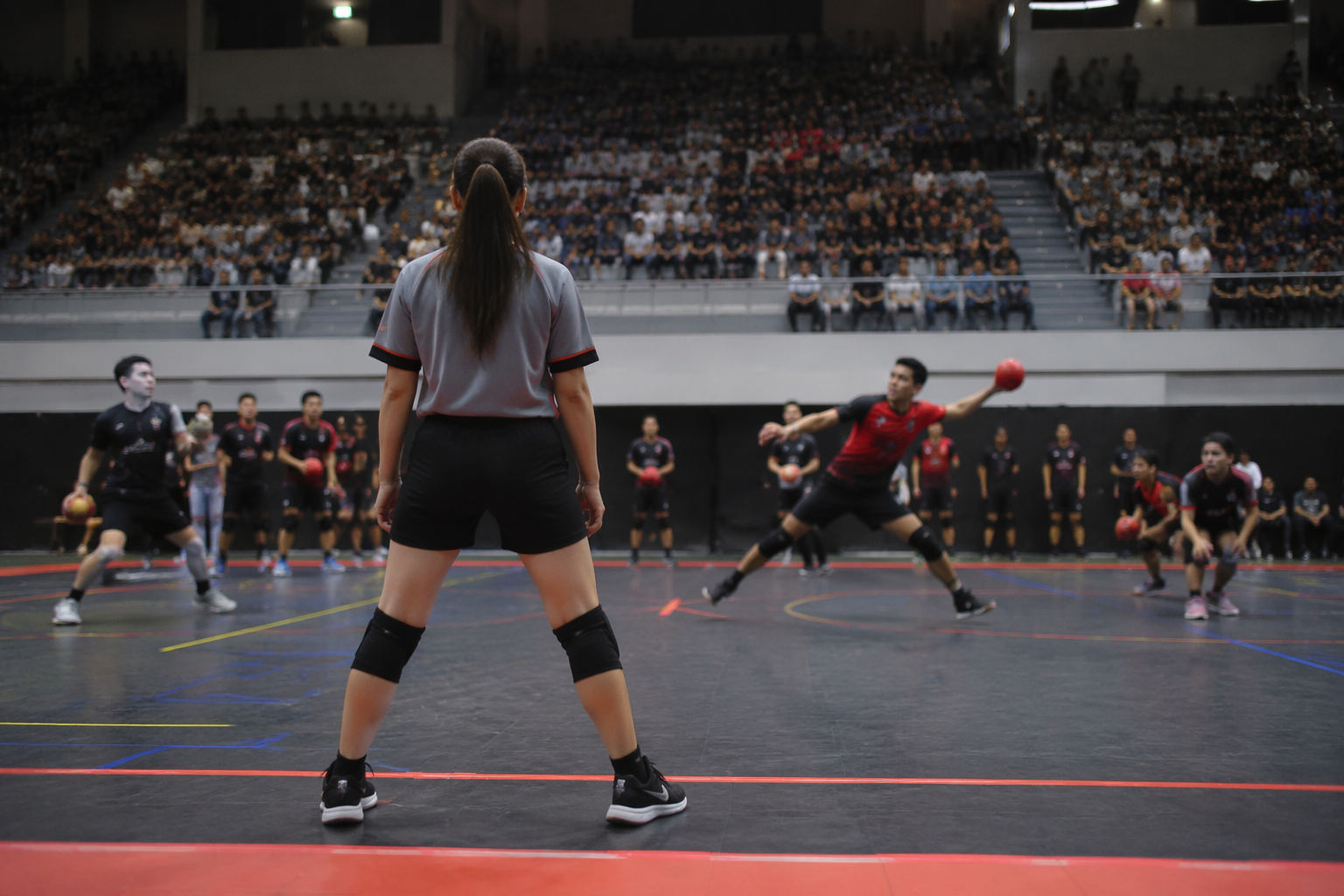
The WDBF rulebook formalizes a match-official structure that includes head referees, line referees, scorekeepers, and timekeepers. In the 2024 rules, that personnel list sits in Part 3 under Officials, showing that the federation treats match control as a distinct part of the competition, not an afterthought. The 2022 final rules go further and specify that the head referees stand on the referee stand on the side of the court across from the team benches, with a maximum of two head referees in the game.
That detail matters because position shapes authority. The head referees are not floating observers; they occupy a defined vantage point across from the benches, where they can track the broader court picture while line referees handle the margins. Scorekeepers and timekeepers complete the chain, making sure the match clock and scoring record stay synchronized with the calls on the floor. In a fast game, that coordination is what keeps the sport honest.
The 2026 rules update and the modern rulebook
On May 8, 2026, the federation announced its updated international rules framework. That revision was developed through consultation with athletes, referees, continental confederations, national federations, and technical leaders, which signals a rules process shaped by the people most likely to feel the consequences of a bad call. The federation also says the current official rules document is the active guide for WDBF-sanctioned events, while previous major rulesets remain available for comparison.
That combination of current authority and archived comparison is useful in a sport that is still standardizing itself across borders. The 2024 and 2022 documents show continuity in the official structure, while the 2026 framework shows the federation adjusting the rulebook with input from across the sport’s international network. For coaches and players, that means the rule environment is not frozen, but it is not arbitrary either.
Training the people who make the calls
The federation’s education program shows how seriously it treats officiating development. Its referee-focused lessons include Safe Refereeing, Referee Communication, and Game Management, and its referee education curriculum adds ethics of officiating, use of technology, timing and recording scores, and positioning. Those are not cosmetic modules. They are the mechanics of how a referee sees the game, communicates a ruling, and keeps the contest moving.
Positioning and timing are especially important in dodgeball because the official often has to process several things at once: the release, the catch window, the line of play, and the game clock. Communication becomes just as critical when a captain is asking for clarity after a disputed elimination or when the benches need a ruling delivered without delay. The curriculum suggests a federation trying to build consistency across officials, not just competence in isolated calls.
How that compares across the sport
The need for trusted officiating is not unique to the WDBF’s top tier. The World Dodgeball Society makes the same basic case in more direct language: referees keep the game moving, ensure player safety, rule on unclear plays, and settle disputes. That is the same job description in leaner form, and it captures why every level of the sport depends on the same core idea, that someone on the court must be recognized as the final interpreter of what just happened.
The stakes rise as the sport expands. When the 2019 World Championships were staged in Cancun, Mexico, they became the first WDBF tournament to feature countries from the European Dodgeball Federation after those countries joined the WDBF. The federation’s world championship history also includes Los Angeles in 2018, which helps show the sport’s recent growth path. As more countries enter the same event structure, officiating standards have to travel with them.
Why this is the sport’s real watchability factor
The reason elite dodgeball feels serious is not just athletic speed. It is the presence of a system that can sort a catch from a trap, a line step from a legal release, and a routine set from sudden death without losing control of the match. The WDBF’s guidelines, rulebooks, and training materials show that officiating is the grammar of the sport, the layer that turns fast movement into shared understanding.
That is why the referee stand, the hand signals, the score table, and the checklist matter as much as the throws. In dodgeball, chaos only becomes competition when the officials are positioned, trained, and trusted well enough to make the game readable in the moment.