World Dodgeball Federation maps throwing skills through age-linked development stages

Fundamentals (U9), Learn To Play (U12), Train To Compete (U15), and Active For Life (U18+) are the four stages in the World Dodgeball Federation’s Player Development Framework. It places players into stages by current skill, not birthday alone, and it treats throwing as one piece of a bigger path built on physical literacy, long-term development, excellence, health and wellbeing, inclusion and diversity, collaboration, safe sport, and leadership.
A framework built for coaches, not just competitors
The framework is a long-term development tool modeled on Sport Canada’s Sport for Life approach. It also points coaches to the SOL model, which stands for Stability, Object Control, and Locomotion, a useful way to sort what a young player can do before asking for more speed, force, or deception.
The WDBF also uses an age-free idea of development. A player who comes late to the sport, whether at 13 or 23, is supposed to enter the stage that matches the mechanics already on display, not the number on a birth certificate. In practice, that means a coach looks first for balance, ball control, and footwork, then builds the throw around those traits.
The throwing ladder, stage by stage
Fundamentals (U9)
At the first stage, the throw is mostly about body control. A player needs to stay stable, move into the throw without falling apart, and release the ball with a repeatable motion that can be seen and corrected. Simple target throws, short-distance catch-and-release work, and plant-step drills help reveal whether the athlete has basic stability and object control before anyone worries about power.
This is also where the earliest throw patterns are easiest to spot. In the elementary-school research on dodgeball mechanics, some younger throwers relied on underhand releases or left out the trunk twist and stepping action that add force and direction. The coaching cue here is plain: keep the player balanced, get the front foot working, and make the release visible enough that the motion can be repeated.
Learn To Play (U12)
This phase is a time of accelerated coordination and fine motor control, which is exactly when the throw starts to become more efficient. Players begin to link locomotion with object control, so the step, shoulder turn, and release start working as one sequence instead of separate pieces. Short approach throws, medicine-ball style turning drills with a light ball, and partner throws that demand a clean step help sharpen that timing.
A 2013 J-STAGE study of 239 elementary school children in grades 1 through 6 videotaped dodgeball throws and identified eight typical throwing patterns, then found that those patterns matured progressively with grade level. The same study found throwing distance increased by grade, which is a reminder that mechanics and output rise together when coordination improves.
Train To Compete (U15)
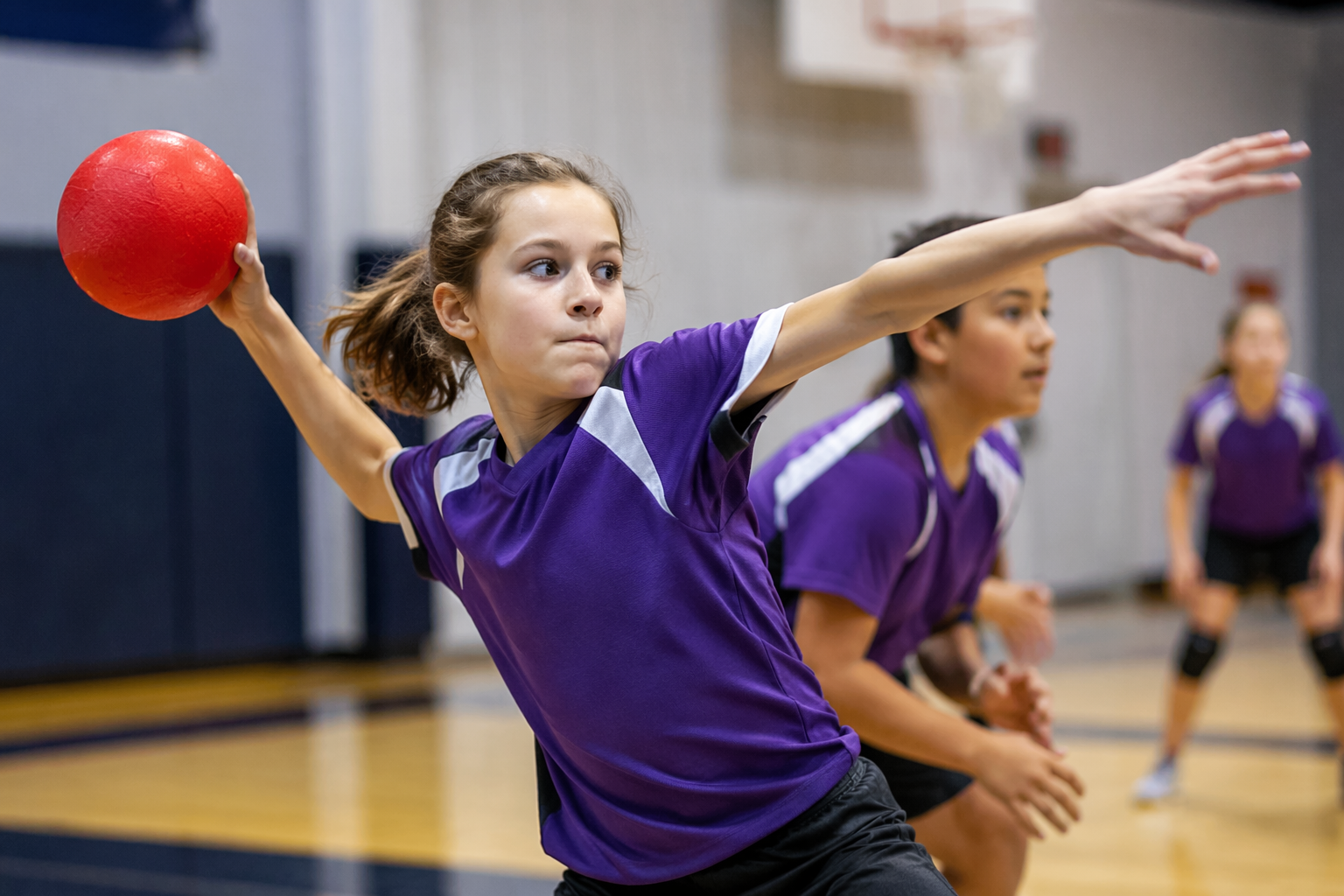
By the time players reach the competitive stage, the throw is no longer just about getting the ball to the target. It becomes a question of angle, sequencing, and the ability to hide intent long enough to create pressure. Coaches start asking whether the athlete can generate power from the ground up, change release points, and use overhand or sidehand actions without losing accuracy.
A study of eight male primary-school players used Vicon three-dimensional motion analysis at 250 Hz to compare overhand and sidehand throwing, showing that the two actions are not the same motion with a different finish. In this stage, cueing the front-foot plant, the trunk rotation, and the hand path matters more than simply telling a player to throw harder.
Active For Life (U18+)
The final stage is less about a ceiling than a standard. Players here need a throw that can survive fatigue, pressure, and changing game situations, whether they are competing seriously or staying in the sport recreationally. The best athletes can still return to the same mechanical basics, then vary pace, trajectory, and release point to keep opponents guessing.
A 2017 PubMed-indexed review concluded that correct throwing technique reflects throwing ability in childhood and that grip strength and aerobic capacity also matter.
What the research says coaches should watch
The throwing studies point to a few clear diagnosis tools. In the J-STAGE work, girls were more likely to use underhand throws or skip trunk twist and stepping mechanics at release, while the broader sample showed that motion changed as children moved through the grades. A second J-STAGE study of 73 boys and girls in grades 2 and 4 focused on developmental characteristics and sex-related differences in throwing motion, reinforcing the idea that coaches should watch the movement pattern, not just the result on the scoreboard.
Drill design should be staged, too. If the ball is short, the problem may be locomotion and release sequencing. If the throw is wild, the athlete may need more object control. If the motion looks powerful but the ball is easy to read, the next step is disguise, timing, and the ability to change arm slot or release point without breaking the whole action.
A sport growing fast enough to need a common language
The WDBF’s development model is arriving as the sport itself expands. The federation formed in July 2011, then staged its first World Championship in Kuala Lumpur in 2012, where Hong Kong won the first men’s gold and a combined Canada-US team took the women’s title. By the 2024 World Championships in Graz, Austria, the federation counted more than 1,300 athletes, coaches, and officials from 123 teams representing 35 countries across six divisions, and it had 70 national federation members in 2025.
The 2026 World Championships will run from December 5 to 13 in Bangkok, Thailand, with a projection of more than 1,500 athletes from more than 50 countries. In May 2026, it also announced an updated international rules framework developed through consultation with athletes, referees, continental confederations, and national federations.