World Outdoor Racquetball brings outdoor play into the mainstream
World Outdoor Racquetball has done more than preserve a niche. It has given racquetball a second home in parks, beach courts, and public spaces, where the sport looks familiar but plays with a different rhythm, a different crowd, and a different set of demands. That split is now the blueprint: outdoor racquetball survives by widening access, lowering barriers, and turning competition into a visible community event.
A parallel universe with the same core game
WOR treats outdoor racquetball as a true branch of the sport, not a novelty. The racquets and ball are the same, and the basic scoring DNA stays intact, but the setting changes everything: weather becomes a factor, the crowd is part of the atmosphere, and the court itself can reshape tactics from one site to the next. In that sense, outdoor racquetball is both racquetball and its own culture, with its own etiquette, pace, and audience.
The rules reflect that difference. Shirts are not required, approved sunglasses replace eye guards, hats take the place of headbands, and sunscreen becomes essential gear. Outdoor courts may have no ceiling or only a limited one, there is no official outdoor court size, and local rule exceptions can override the defaults. WOR also recognizes one-wall and three-wall courts, which makes the game far more adaptable to public spaces than the indoor model tied to standard club infrastructure.
That flexibility matters because it changes who can walk into the sport. Outdoor racquetball does not depend on a polished club environment or a fixed indoor footprint. It can live on public courts, at parks, and in places where the game is visible to passersby, which is exactly why WOR has worked so hard to standardize the experience without stripping away the outdoor identity.
Why the outdoor game feels different on the court
Outdoor racquetball rewards a different kind of athletic problem-solving. WOR’s own framing captures the sport at its most dramatic: players diving on concrete, stretching for balls in the sun, and chasing kill shots from long distances. Those conditions produce rallies that can be more open, more improvisational, and more reliant on timing, shot selection, and stamina than the enclosed indoor game.
The social atmosphere is different too. Outdoor tournaments often feel like festivals, with crowd interaction built into the day and matches unfolding in a setting that is more public and less sealed off than a club event. That visibility is not just cosmetic. It gives the sport an easier entry point for newcomers, since a public court creates curiosity in a way that a private facility often cannot.
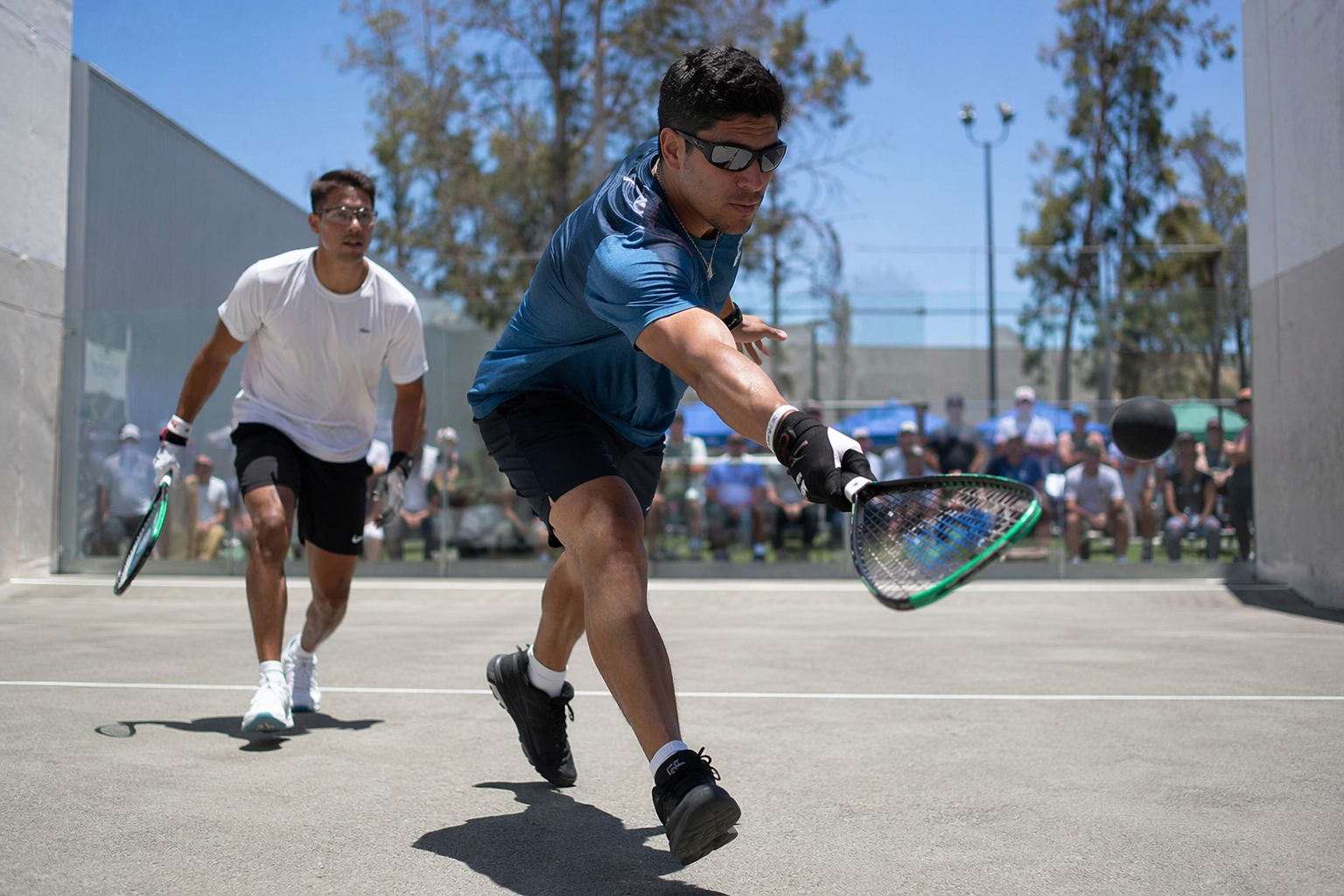
The court list makes that public-space reality concrete. WOR tracks one-wall, three-wall, and four-wall courts and asks for details such as whether the court has a ceiling or lights, how much room sits behind the playing area, and whether access is limited by park hours or reservations. Bill George maintains that living map, and that alone tells the story: outdoor racquetball depends on an evolving network of places, not a single permanent venue system.
The history behind the modern outdoor game
Hank Marcus is central to the sport’s outdoor identity. His WOR Hall of Fame profile credits him with founding World Outdoor Racquetball with support from Scott Winters and Ektelon, then building it from a California base into a network that reached 17 states with outdoor courts. The same lineage extends beyond the United States, with junior programs in Mexico, Venezuela, England, and Spain showing how the outdoor version became an international entry point rather than a local sideline.
Marcus’s priorities reveal how the outdoor game matured. He pushed for a visible outdoor ball, new serving rules that could create longer rallies, and webcasts of WOR championships. Later, a collaboration with 3WallBall helped produce a large mixed racquetball-and-handball mega event in Las Vegas, a reminder that outdoor racquetball has always been open to cross-pollination when it helps the sport reach more players and spectators.
The competition history is equally important. WOR’s Hall of Fame record says the first One Wall National Championships at Hollywood Beach took place in 2004, expanding the competitive map beyond the sport’s traditional beach strongholds. That event sits alongside Huntington Beach as a signature outdoor stage, proving the format can travel while still keeping its identity rooted in public venues and strong local followings.
Outdoor Nationals remains the anchor event
If WOR is the ecosystem, Outdoor Nationals is its spine. The event began in 1974 at Orange Coast College in Costa Mesa, California, when Bob Wetzel and Barry Wallace helped create what became racquetball’s outdoor showcase. The first singles champions were Charlie Brumfield and Betty Weed, and the original courts measured 23x46, larger than the standard 40x20 indoor court. Those dimensions produced distinct tactics and playing styles that still define outdoor specialists today.
The tournament’s competitive lineage is unusually deep. Jim Carson took over after roughly a decade, and the early 1980s were dominated by outdoor names such as Mark Harding, Paul Olson, Martha McDonald, Diane Heims, Dave Trent, Dan Southern, and Steve Fey. Brian Hawkes won the first of his 20 Outdoor Nationals singles titles in 1981, a run that underlines just how durable the outdoor circuit’s elite class has been.
The event’s longevity carries real symbolic weight. Outdoor Nationals marked its 50th anniversary in 2024, and a 2026 announcement places it in its 52nd year at Marina Park in Huntington Beach, California, from July 10-12, 2026. That continuity gives outdoor racquetball a rare asset: a flagship event with enough history to anchor the present and enough visibility to keep the sport in public view.
The current calendar shows a live, not nostalgic, scene
The outdoor circuit is active right now, and WOR’s June 2026 update shows an organization still trying to pull the community together. Tournament directors are being urged to register events under the correct WOR organization in R2sports so they appear on the updated WOR webpage and upcoming-events widget. That kind of administrative detail sounds small, but it is a big part of how a decentralized sport stays discoverable.
The event list tells the same story. SacTown Sizzler 3Wall Smash, Outdoor Nationals and World Championships at Marina Park, One Wall Palooza in Stockton, and Belle Isle Longwall Championships in Detroit all point to a circuit built around repeat gatherings in specific places. Planned events in Virginia and Florida extend that footprint further, showing that outdoor racquetball keeps moving through parks and cities rather than waiting for club schedules to dictate its future.
That is the clearest lesson for indoor organizers. Outdoor racquetball succeeds because it is public, flexible, and easy to see. It does not hide behind private walls, and it does not require a perfectly uniform venue to feel legitimate. It builds loyalty through access, local maintenance, and a tournament culture that invites both competition and spectatorship.
A model for survival and growth
The outdoor game is not competing with indoor racquetball so much as proving that racquetball can thrive in more than one environment. WOR has standardized rules where it can, embraced variation where it must, and used events like Outdoor Nationals to give the sport a public stage. Its Hall of Fame culture, its court map, its 2026 event calendar, and its long run from Costa Mesa to Huntington Beach all point to the same conclusion: outdoor racquetball is not a sideshow. It is a parallel system that shows how the sport can widen its reach without losing what makes it unmistakably racquetball.