On December 28, 1958, roughly 45 million Americans watched a football game end in a way no NFL championship ever had — sudden-death overtime, a fullback crashing into the end zone, and a sport that would never look quite the same again.
The Night Pro Football Changed Forever
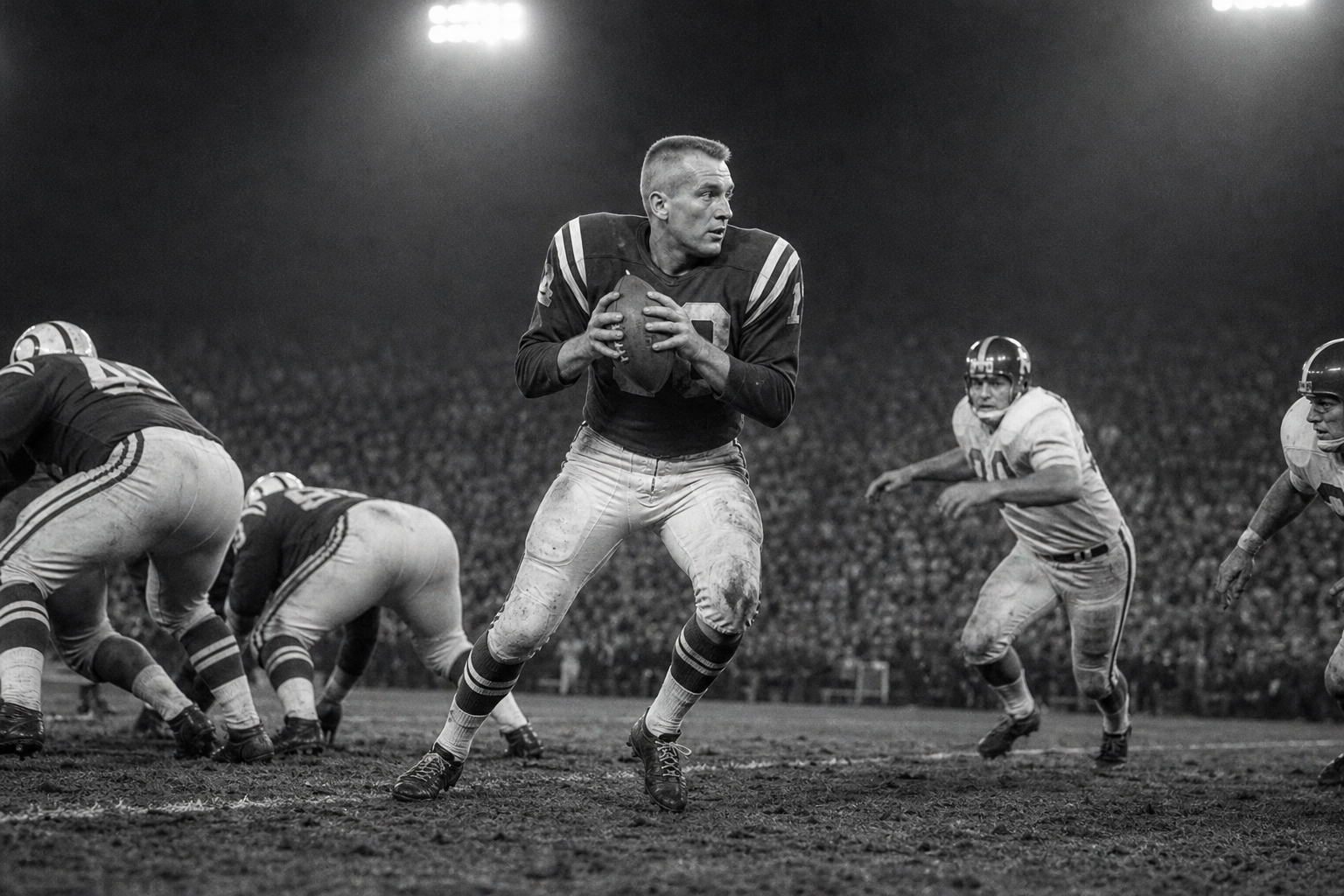
The Baltimore Colts’ 23–17 victory over the New York Giants in the 1958 NFL Championship Game did not just decide a title. It handed the NFL something it had been desperately chasing for years: proof that professional football could command a national audience, hold it through crisis and comeback, and deliver a finish so dramatic that few who watched it could claim they had seen anything like it before.
The events described here are verified and dated. This is not breaking news — but it is a story worth understanding precisely because its consequences remain visible every Sunday, in every television contract, every two-minute drill, and every overtime coin toss.
What Was Actually at Stake
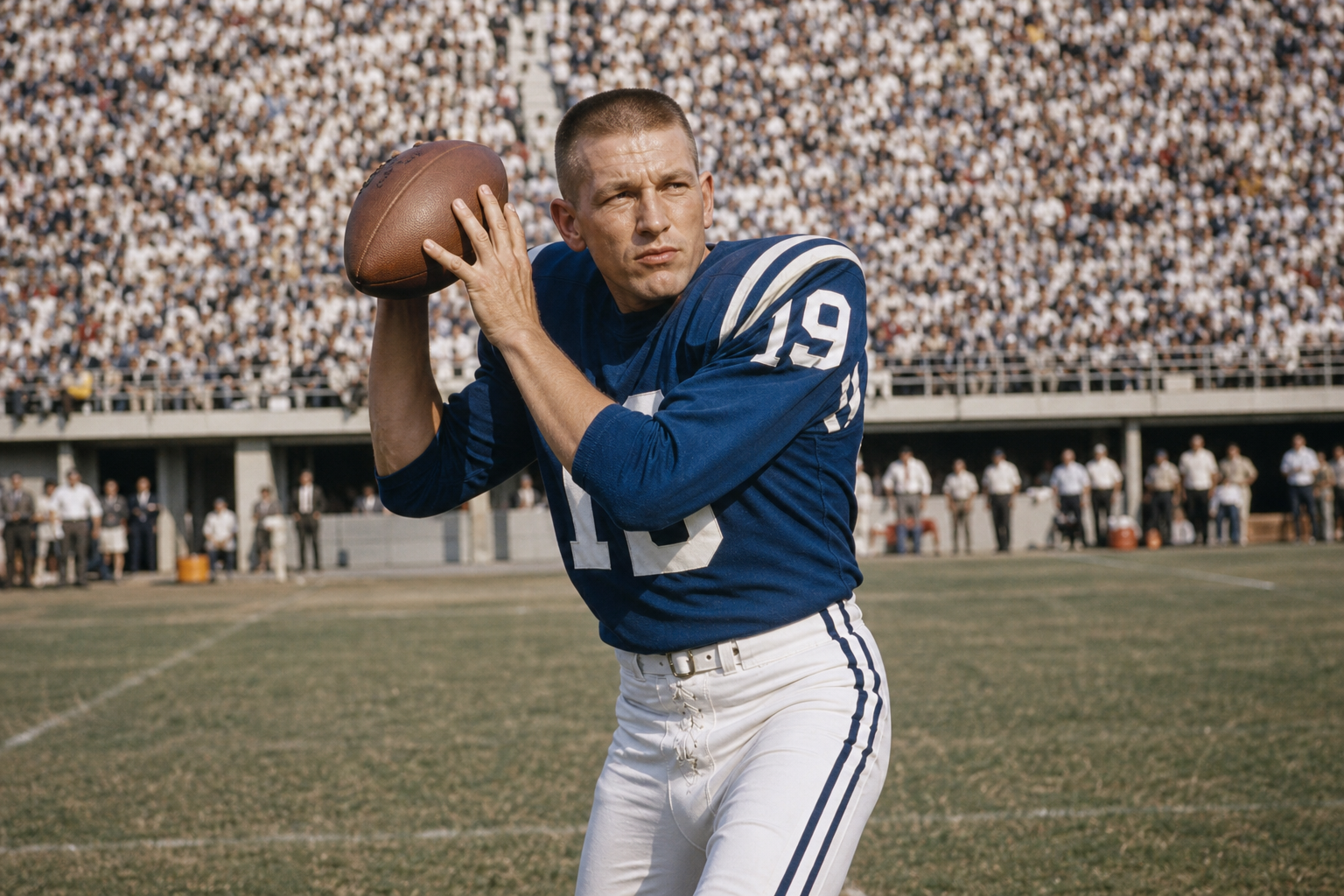
The Colts entered the game chasing their first championship in franchise history. Baltimore was not glamorous. It was a mid-sized, blue-collar city whose quarterback — Johnny Unitas — had been cut by the Pittsburgh Steelers before the Colts took a chance on him as a walk-on in 1956. His path to Yankee Stadium was improbable by any measure.
The Giants were everything the Colts were not: established, celebrated, playing in the country’s largest media market. New York’s defense, anchored by linebacker Sam Huff, defensive end Andy Robustelli, and safety Emlen Tunnell, was considered among the finest the NFL had assembled in the postseason era. The Giants had shut down Cleveland’s Jim Brown in a divisional playoff just weeks earlier, holding him to eight yards rushing.
Beyond the matchup itself, the NFL in 1958 was fighting for cultural relevance. College football commanded enormous regional followings. Baseball still marketed itself as the national pastime and had attendance figures to support the claim. Pro football needed a moment that could be felt simultaneously across the country. Yankee Stadium, packed with 64,185 fans, hosted the game — but the more consequential arena was the living room.
The Television Broadcast That Made It a National Event
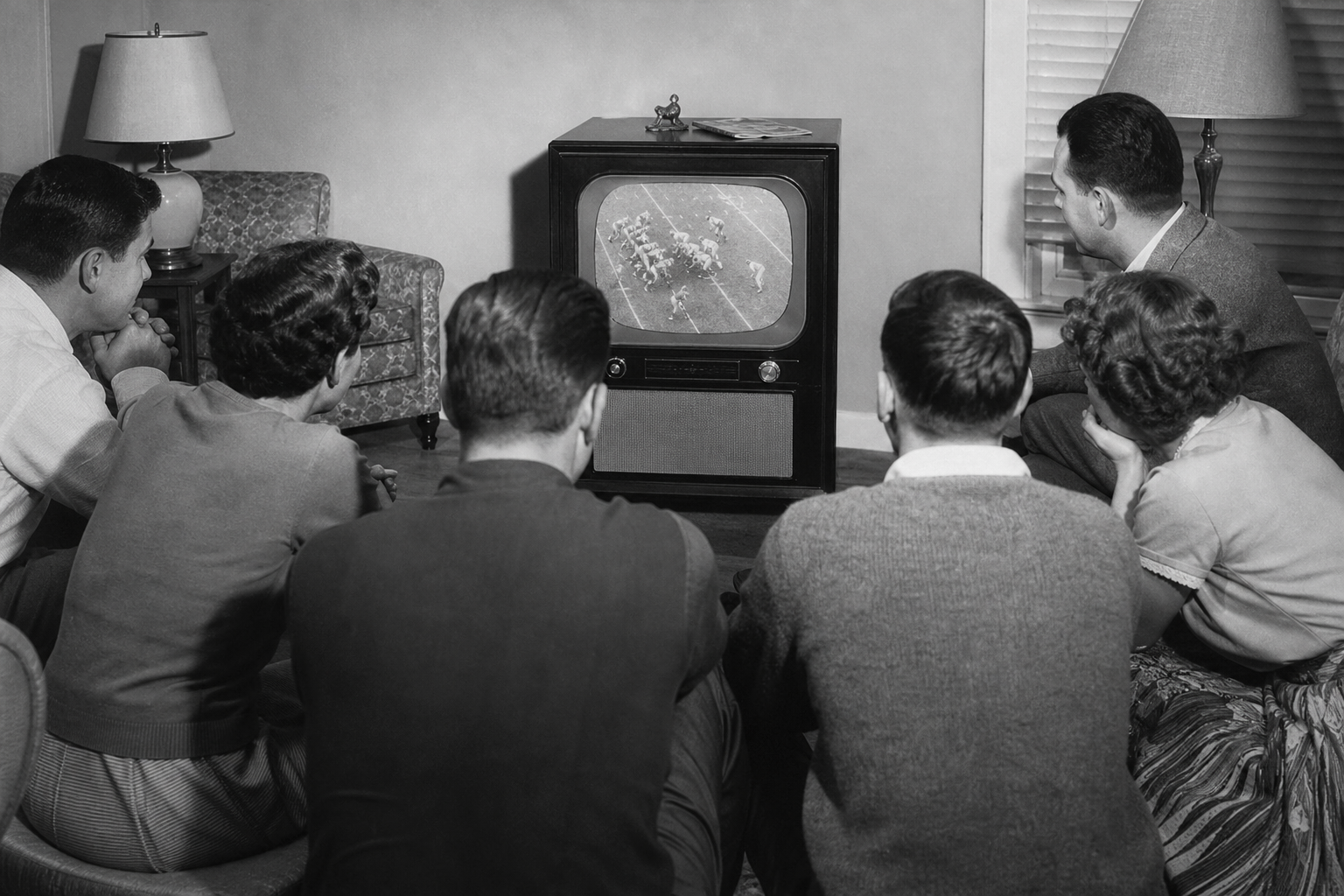
The 1958 championship was the first NFL title game distributed by a single network to a truly national television audience. NBC carried it coast to coast, reaching an estimated 45 million viewers — a figure that reframed how advertisers, broadcasters, and the league itself understood pro football’s commercial potential.
NFL Commissioner Bert Bell had spent years arguing that the sport’s tempo and physicality translated to television better than almost any other game. This broadcast became his clearest evidence. The landmark league-wide television agreement that followed in 1962 — which pooled all teams’ broadcast rights and distributed revenue equally, a structure that prevented large-market franchises from financially overwhelming small-market ones — was built on the foundation this audience demonstrated was possible.
Without the NBC broadcast reaching those 45 million homes, the overtime drive, the fumbles, and the two-minute march would have been witnessed only by one stadium crowd rather than a generation of fans who would grow up treating pro football as the dominant American sport. The game’s drama mattered; the scale at which it was witnessed is what made it historically transformative.
The Giants’ Self-Destruction: Six Fumbles and a Title Slipping Away
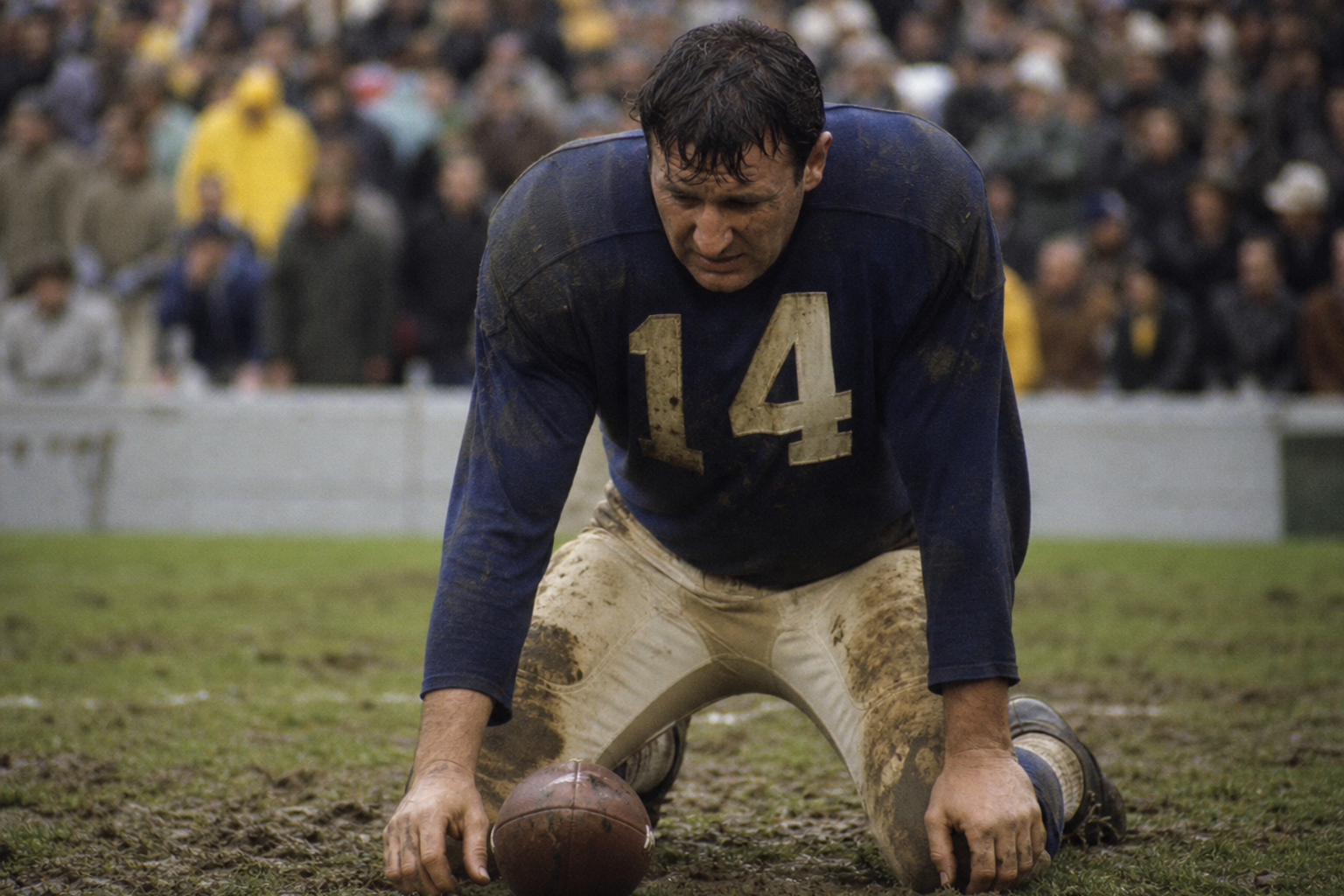
New York’s performance was a study in costly errors. The Giants lost six fumbles during the game — a figure that repeatedly handed Baltimore possession and momentum at critical moments. For context: a fumble occurs when a ball-carrier loses possession after contact and the opponent recovers; losing six in a single game is roughly three times the modern single-game average. In a championship, each turnover is a potential season-ender gifted to the opposition.
The Giants also surrendered an interception and missed a field goal attempt, meaning New York’s offense created multiple Baltimore scoring opportunities that did not require the Colts to earn them through their own execution. The cumulative damage from turnovers was severe enough to have ended most games long before the final whistle.
What makes New York’s performance genuinely remarkable rather than simply poor is what the Giants accomplished despite all of it. They trailed just 14–3 at halftime and clawed back to lead 17–14 with under two minutes remaining. That comeback — driven almost entirely by a defense that absorbed wave after wave of Baltimore pressure — is precisely what set the stage for the most consequential drive in NFL history to that point.
Johnny Unitas and the Two-Minute Drive That Defined a Position
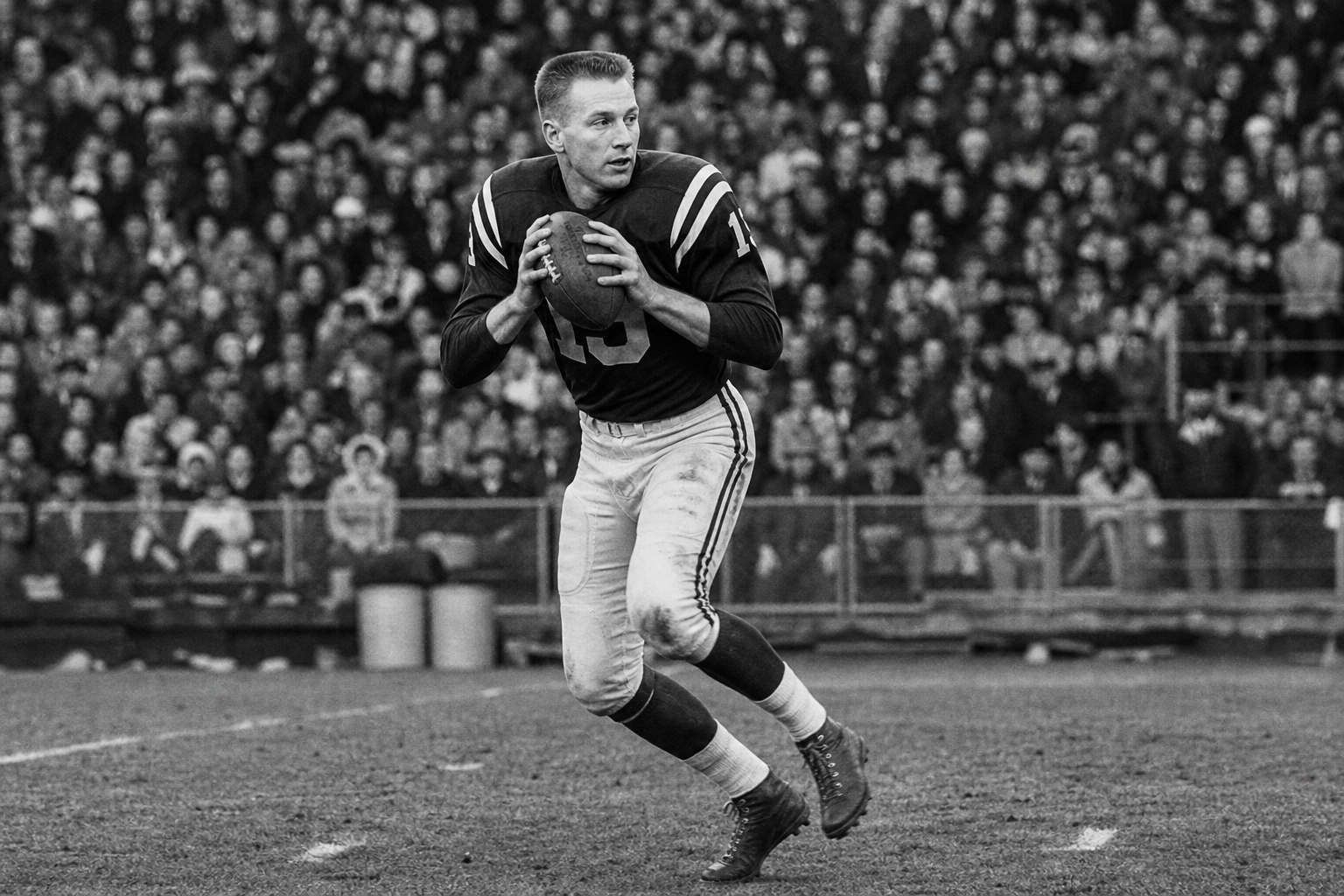
With the Giants leading 17–14 and 1:56 remaining on the clock, Unitas took the field without a timeout. What followed was a drive that ended with a Steve Myhra field goal, tying the game at 17–17 and sending it to overtime. According to the Pro Football Reference game log for the 1958 NFL Championship, Unitas finished the afternoon completing 26 of 40 passes for 349 yards and one touchdown.
The tying drive is considered one of the earliest and most visible examples of what would become known as the “two-minute offense” — a fast-paced, spread-the-field approach that is now standard practice at every level of football from high school through the NFL. Unitas called his own plays, processed coverage reads in seconds, and controlled a moment that would have overwhelmed most quarterbacks of that era.
It overstates the case to call Unitas the sole architect of the modern quarterback role — the position evolved through many players and coaches across decades. But the 1958 championship is the unambiguous moment that archetype became visible to a mass national television audience for the first time. That visibility shaped franchise expectations of the position for the next half-century, and echoes of it are present every time an NFL offense takes the field trailing in the final two minutes.
Sudden Death: The Overtime Nobody Had Seen Before in a Championship
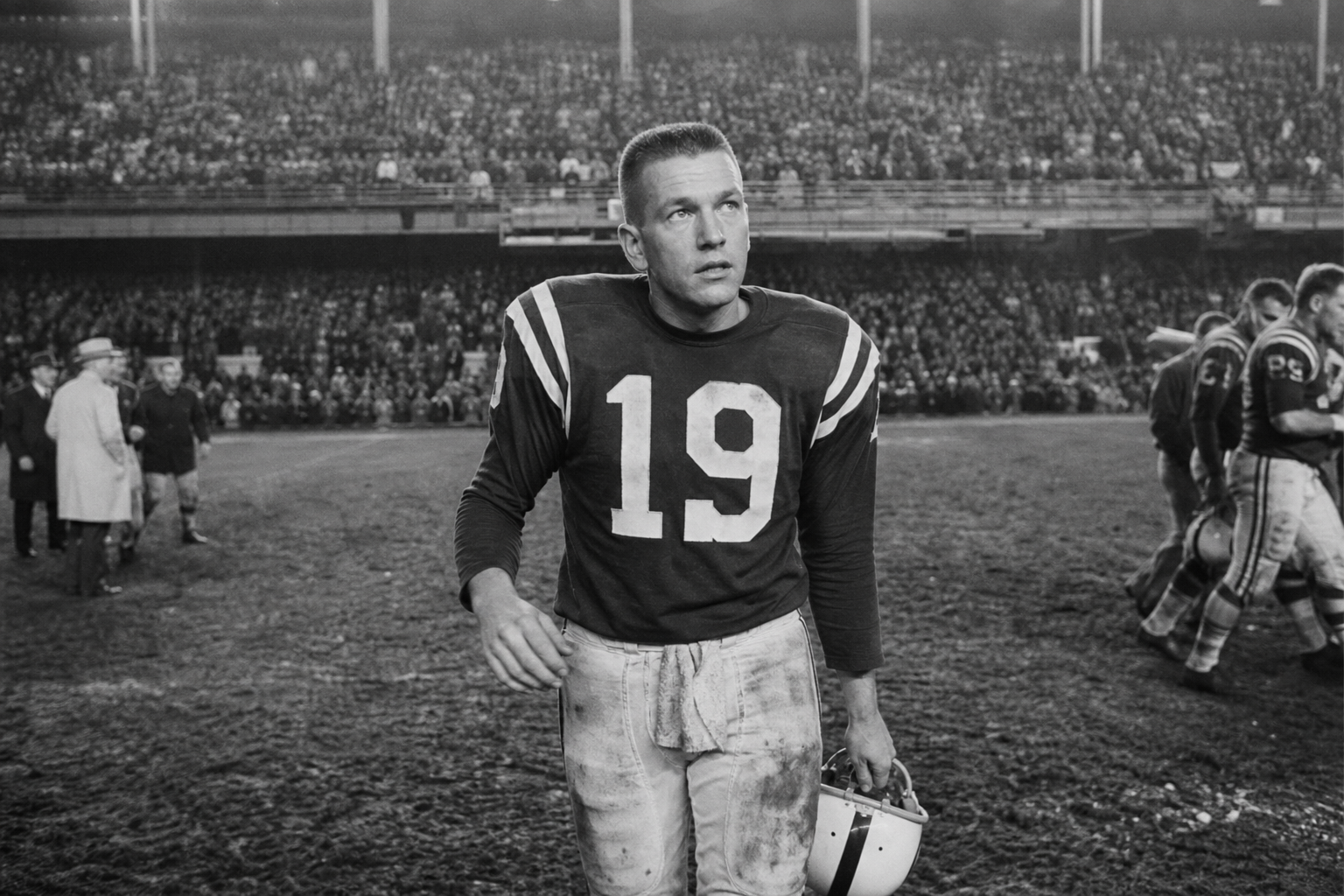
When regulation ended tied at 17–17, the tens of millions watching at home encountered a rule most had never seen applied in a title game. NBC’s announcers explained sudden-death overtime in real time: the first team to score any points wins immediately, the game ends on that score, there is no playing out the full period. That live explanation, delivered to an audience of this size, became part of the broadcast’s electricity.
The NFL had technically adopted sudden-death rules for tied regular-season games in 1955, but the 1958 championship was the first time those rules had ever been applied in a postseason context. It was, by the sport’s own standards, genuinely unprecedented territory.
The Colts won the overtime coin toss. What followed was an 80-yard drive spanning 13 plays — methodical, patient, and ultimately unstoppable. Unitas, who had already delivered one defining drive that afternoon, moved Baltimore deep into Giants territory. Then, on a one-yard run, fullback Alan Ameche took a handoff off right tackle and scored the winning touchdown, giving the Colts the 23–17 victory. You can watch the final moments in NFL Films’ archival footage compiled in this Top 10 Overtime Finishes breakdown, which preserves how charged the ending remained long after the fact.
Why “The Greatest Game Ever Played” Still Earns Its Nickname
The label arrived almost immediately, coined by sportswriters in the days following the game and later popularized by David Harris’s 2006 book of the same title. The claim is an editorial judgment rather than a measurable record — no formula exists for ranking games across eras, and other candidates exist. But the case for the 1958 championship rests on structural evidence, not sentiment alone.
The game accelerated the television contracts that funded the league’s expansion through the 1960s. It helped legitimize the American Football League, which launched in 1960 partly emboldened by evidence that pro football could dominate national television ratings. The AFL’s competition with the NFL drove both leagues toward the 1966 merger agreement and the Super Bowl format that defined American sports culture for the next half-century. Both franchises have documented the game’s enduring significance in their own institutional histories: the Colts’ official retrospective and the Giants’ historical archive each examine how thoroughly December 28, 1958 shaped their respective identities and the broader league.
The Colts’ victory was also, at its core, the story of a small-market franchise beating the establishment on the largest possible stage — a narrative the sport has leaned on ever since, from Super Bowl upsets to late-seed playoff runs that capture the country’s attention precisely because they mirror what Baltimore accomplished that afternoon.
Sixty-six years on, the 1958 NFL Championship Game remains the clearest single inflection point at which professional football stopped being a regional attraction and started becoming a television institution. That transformation began at Yankee Stadium, in overtime, on a one-yard run by a fullback into an end zone the whole country was watching.