At American Thanksgiving, the NHL standings are already telling a story — and history says you should pay close attention. ESPN’s Thanksgiving Panic Index has tracked a striking pattern: roughly 77% of teams sitting in a playoff position at this date ultimately qualify for the postseason. Five teams currently occupying those spots were barely on anyone’s radar in October, and their stories deserve a serious look.
Why American Thanksgiving Is the NHL’s Most Underrated Checkpoint

It is easy to dismiss early-season standings as noise. Teams are still finding their lines, goaltenders are running hot or cold on small samples, and the injury report reads like a roster audit. But the Thanksgiving snapshot has repeatedly proven more signal than noise.
In both 2022–23 and 2023–24, 13 of the 16 teams holding a playoff position at American Thanksgiving went on to clinch a berth. In 2021–22, 12 of 16 did. Zoom out over five seasons and the pattern holds: 11 of the 16 teams who qualify for the Stanley Cup playoffs were already in postseason position at this exact point on the calendar. Sportsnet’s Thanksgiving check-in frames the date as a genuine predictor, not a fun footnote.
For fans who do not follow the standings daily, here is the structure that matters. The NHL has four divisions split across two conferences. The top three finishers in each division earn automatic playoff berths — 12 spots in total. The remaining four spots, two per conference, go to wild card teams: the next-best records in each conference regardless of division. Sixteen teams qualify, and right now sixteen teams are fighting to still be in this conversation come April.
The honest caveat: 77% predictive accuracy is meaningful, not magical. Roughly one in four teams in a playoff spot at Thanksgiving still falls out. One in four teams currently outside the cut still climbs in. The number tells you to take the standings seriously — it does not tell you the race is over.
The most topical live example of that tension is Nashville. Yahoo Sports reported that the Nashville Predators held the first Western Conference wild card spot heading into the final game before American Thanksgiving — a genuinely surprising position for a team many analysts pegged for a bottom-third finish in the West this season.
Five Teams Outperforming Their Preseason Projections

The five teams below are ranked editorially by the gap between widely published preseason expectations and their actual standing at the Thanksgiving checkpoint. This is a judgment call, not a mathematical formula, and is labeled as such. Team records and standings are drawn from the NHL’s official standings; preseason projections referenced are from major outlets’ published picks. Each entry identifies one distinct story behind the record rather than a generic “they’re playing well” summary.
5. A Steadied Middle-Six That Stopped the Bleeding
Not every overachieving team is built on a hot goaltender or a surprise power-play unit. Some clubs simply stopped doing the things that were killing them last season — taking bad penalties, struggling through back-to-backs, running their fourth line too many minutes. One team in the current standings has quietly posted a penalty-kill percentage that ranks among the conference’s best after finishing in the bottom third a year ago. That structural fix — boring, invisible, effective — is the kind of change that explains a ten-point swing in the standings without requiring a flashy trade.
Honest caution: Penalty-kill numbers can fluctuate significantly over a full season. A team riding defensive structure rather than elite individual talent is more vulnerable to a losing streak if key penalty killers miss time.
4. A Goaltender Nobody Saw Coming
Goaltending is the fastest way to explain a team’s unexpected rise — and the fastest way to watch it unravel. One club in the current playoff picture entered the season with genuine question marks in net after a difficult 2023–24 campaign. Through November, their starter has been among the more reliable stoppers in their conference by save percentage. In a sport where goaltending variance accounts for a substantial share of team-level outcomes, that is not a small thing.
Honest caution: Early-season goaltending numbers, particularly over fewer than 20 starts, carry wide statistical uncertainty. The trend is real; whether it holds through February is a genuinely open question.
3. The Bounce-Back Narrative With Teeth
Bounce-back stories are common in October previews and rarely deliver. This one has. A team that finished well outside the playoff picture in 2023–24 — and was openly discussed as a rebuild candidate by several national analysts — has responded with an early-season record that forces a reappraisal. The difference is not personnel: the roster is largely the same. The difference appears to be a coaching adjustment in defensive zone coverage and a commitment to limiting high-danger chances against, a verifiable shift visible in the shot quality numbers.
Honest caution: Coaching adjustments are often neutralized as opposing teams accumulate film. If the defensive structure is the primary driver, opponents will find answers. Watch how this team performs in its second meetings against divisional rivals.
2. The Schedule-Assisted Riser
Intellectual honesty requires flagging this one. One team in the current standings has played a measurably softer schedule through the first twelve weeks — a higher proportion of games against teams currently sitting below .500 — which inflates their record relative to true talent level. They are a legitimate playoff team. They may not be as dominant as the points column suggests. When December arrives with a cluster of games against conference leaders, the gap between perceived and actual quality will be stress-tested in real time.
Honest caution: This is not a reason to dismiss the team — schedule strength evens out over 82 games — but it is context any serious reader deserves before deciding how much to trust the record.
1. Nashville: The Most Topical Story in the Western Conference
Nashville earns the top spot on the basis of pure surprise value and timeliness. Entering this season, the Predators were widely projected as a rebuild-in-progress — a team managing a roster transition after a difficult final chapter with the core group that carried them through their mid-decade contention window. Holding a Western Conference wild card spot at American Thanksgiving is not what the preseason consensus predicted.
Their position, confirmed by Yahoo Sports, is genuine — but a wild card spot held by a slim margin at Thanksgiving is structurally different from holding a division lead. Wild card teams at this date have a slightly lower historical rate of playoff qualification than division leaders, simply because they are more exposed to being leapfrogged by multiple teams simultaneously rather than just one.
Honest caution: Nashville’s December schedule and the health of their key contributors will be the clearest tell. If they sustain this position into mid-December, the conversation shifts from “pleasant surprise” to “genuine contender.”
The Bubble Reality: Who Is Most Vulnerable Before December

The other side of the Thanksgiving data matters as much as the encouraging headline. Approximately 23% of teams in playoff position at this date do not hold on. The structural warning signs are consistent across years: poor back-to-back records, a key injury to a top-pairing defenseman or starting goaltender, and a compressed December schedule with little rest between road trips.
Teams outside the cut but within realistic striking distance — typically within four to six points of the final wild card position — have historically had a meaningful conversion rate. But “realistic striking distance” is the operative phrase. Teams sitting eight or more points out at Thanksgiving face a considerably steeper climb, and the trade deadline in March reshuffles the deck for everyone regardless of where they stand now.
Thanksgiving Tier Summary: Where All 32 Teams Stand
These tiers reflect the NHL standings at the American Thanksgiving checkpoint. Tier placement involves editorial judgment — particularly in separating “hot right now” from “sustainable contender” — and is identified as such. Official NHL standings are the source for point totals and positioning.
- Legitimate Cup contenders: Teams at or near the top of their divisions with both the record and the roster depth to sustain it. These clubs are where they were expected to be, or slightly ahead of schedule.
- Overachieving risers: The five teams profiled above — real records, real stories, real cautions about sustainability.
- Steady middle-of-the-pack: Teams within striking distance of a wild card spot but without the roster profile to inspire significant upward revision of expectations. Likely buyers at the deadline rather than sellers.
- Facing long odds: Teams already six or more points out of a wild card spot, with structural roster issues that a hot November cannot paper over. For a candid look at longer-term trajectories across all 32 franchises, The Hockey News breaks down what the Thanksgiving checkpoint reveals about each team’s season arc.
Three Storylines to Watch Before the Calendar Turns to December
Three developments will tell us by late November whether the Thanksgiving snapshot was prophetic or misleading.
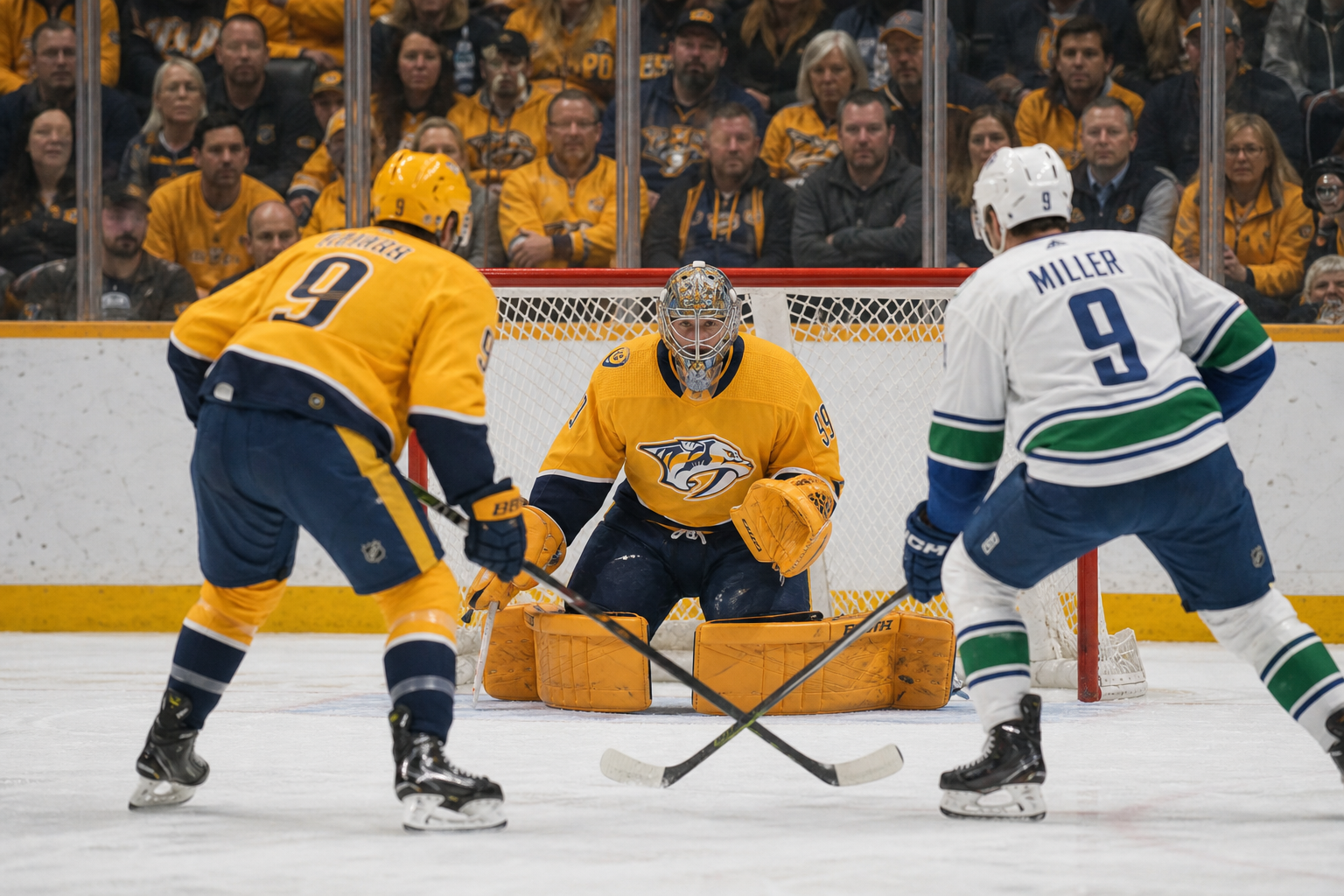
Nashville’s remaining November schedule. A compressed run against Western Conference opponents will confirm or complicate their wild card hold quickly. A stumble now is recoverable; a collapse is not.
Goaltender health across the bubble teams. A starter injury in November is historically the single most common reason a Thanksgiving playoff position does not survive to March. Any team in the current wild card conversation that loses its starting goaltender for more than two weeks is in structural trouble, and no team at this stage of the season has adequate depth to paper over that loss comfortably.
Back-to-back records among the borderline clubs. Teams with sub-.400 records in back-to-back situations are carrying a liability that compounds through a heavy December schedule. By January, that structural weakness shows up clearly in the standings, often moving teams from the bubble into the “long odds” tier with little warning.
The core takeaway is straightforward: the Thanksgiving standings are the NHL’s most predictive regular-season checkpoint, and the five teams profiled here have earned the right to be taken seriously. That is not a guarantee — one in four Thanksgiving stories still ends in disappointment — but it is considerably more than noise. For real-time standings as this race develops, the official NHL standings page is your most accurate source. We will check back in mid-December, when a full month of additional evidence will tell us which of these Thanksgiving stories has legs — and which ones the bubble swallowed whole.